Wave–particle duality
| Part of a series of articles about |
| Quantum mechanics |
|---|
|
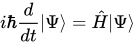
Wave–particle duality is the concept in quantum mechanics that fundamental entities of the universe, like photons and electrons, exhibit particle or wave properties according to the experimental circumstances.[1]: 59 It expresses the inability of the classical concepts such as particle or wave to fully describe the behavior of quantum objects.[2]: III:1-1 During the 19th and early 20th centuries, light was found to behave as a wave, then later was discovered to have a particle-like behavior, whereas electrons behaved like particles in early experiments, then later were discovered to have wave-like behavior. The concept of duality arose to name these seeming contradictions.
- ^ Messiah, Albert (1966). Quantum Mechanics. North Holland, John Wiley & Sons. ISBN 0486409244.
- ^ Feynman, Richard P.; Leighton, Robert B.; Sands, Matthew L. (2007). Quantum Mechanics. The Feynman Lectures on Physics. Vol. 3. Reading/Mass.: Addison-Wesley. ISBN 978-0-201-02118-9.