| Transitive binary relations
|
| Symmetric | Antisymmetric | Connected | Well-founded | Has joins | Has meets | Reflexive | Irreflexive | Asymmetric | | | | Total,
Semiconnex | | | | | Anti-
reflexive | | | Equivalence relation | Y | ✗ | ✗ | ✗ | ✗ | ✗ | Y | ✗ | ✗ | | Preorder (Quasiorder) | ✗ | ✗ | ✗ | ✗ | ✗ | ✗ | Y | ✗ | ✗ | | Partial order | ✗ | Y | ✗ | ✗ | ✗ | ✗ | Y | ✗ | ✗ | | Total preorder | ✗ | ✗ | Y | ✗ | ✗ | ✗ | Y | ✗ | ✗ | | Total order | ✗ | Y | Y | ✗ | ✗ | ✗ | Y | ✗ | ✗ | | Prewellordering | ✗ | ✗ | Y | Y | ✗ | ✗ | Y | ✗ | ✗ | | Well-quasi-ordering | ✗ | ✗ | ✗ | Y | ✗ | ✗ | Y | ✗ | ✗ | | Well-ordering | ✗ | Y | Y | Y | ✗ | ✗ | Y | ✗ | ✗ | | Lattice | ✗ | Y | ✗ | ✗ | Y | Y | Y | ✗ | ✗ | | Join-semilattice | ✗ | Y | ✗ | ✗ | Y | ✗ | Y | ✗ | ✗ | | Meet-semilattice | ✗ | Y | ✗ | ✗ | ✗ | Y | Y | ✗ | ✗ | | Strict partial order | ✗ | Y | ✗ | ✗ | ✗ | ✗ | ✗ | Y | Y | | Strict weak order | ✗ | Y | ✗ | ✗ | ✗ | ✗ | ✗ | Y | Y | | Strict total order | ✗ | Y | Y | ✗ | ✗ | ✗ | ✗ | Y | Y | | Symmetric | Antisymmetric | Connected | Well-founded | Has joins | Has meets | Reflexive | Irreflexive | Asymmetric | Definitions,
for all  and and  |  | 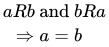 |  |  |  |  |  |  |  |
|
Y indicates that the column's property is always true for the row's term (at the very left), while ✗ indicates that the property is not guaranteed
in general (it might, or might not, hold). For example, that every equivalence relation is symmetric, but not necessarily antisymmetric,
is indicated by Y in the "Symmetric" column and ✗ in the "Antisymmetric" column, respectively.
All definitions tacitly require the homogeneous relation  be transitive: for all be transitive: for all  if if  and and  then then 
A term's definition may require additional properties that are not listed in this table.
|
In mathematics, especially order theory, a partial order on a set is an arrangement such that, for certain pairs of elements, one precedes the other. The word partial is used to indicate that not every pair of elements needs to be comparable; that is, there may be pairs for which neither element precedes the other. Partial orders thus generalize total orders, in which every pair is comparable.
Formally, a partial order is a homogeneous binary relation that is reflexive, antisymmetric, and transitive. A partially ordered set (poset for short) is an ordered pair  consisting of a set
  (called the ground set of
  ) and a partial order
  on . When the meaning is clear from context and there is no ambiguity about the partial order, the set itself is sometimes called a poset.