| Transitive binary relations
|
| Symmetric | Antisymmetric | Connected | Well-founded | Has joins | Has meets | Reflexive | Irreflexive | Asymmetric | | | | Total,
Semiconnex | | | | | Anti-
reflexive | | | | Y | ✗ | ✗ | ✗ | ✗ | ✗ | Y | ✗ | ✗ | | Preorder (Quasiorder) | ✗ | ✗ | ✗ | ✗ | ✗ | ✗ | Y | ✗ | ✗ | | Partial order | ✗ | Y | ✗ | ✗ | ✗ | ✗ | Y | ✗ | ✗ | | Total preorder | ✗ | ✗ | Y | ✗ | ✗ | ✗ | Y | ✗ | ✗ | | Total order | ✗ | Y | Y | ✗ | ✗ | ✗ | Y | ✗ | ✗ | | Prewellordering | ✗ | ✗ | Y | Y | ✗ | ✗ | Y | ✗ | ✗ | | Well-quasi-ordering | ✗ | ✗ | ✗ | Y | ✗ | ✗ | Y | ✗ | ✗ | | Well-ordering | ✗ | Y | Y | Y | ✗ | ✗ | Y | ✗ | ✗ | | Lattice | ✗ | Y | ✗ | ✗ | Y | Y | Y | ✗ | ✗ | | Join-semilattice | ✗ | Y | ✗ | ✗ | Y | ✗ | Y | ✗ | ✗ | | Meet-semilattice | ✗ | Y | ✗ | ✗ | ✗ | Y | Y | ✗ | ✗ | | Strict partial order | ✗ | Y | ✗ | ✗ | ✗ | ✗ | ✗ | Y | Y | | Strict weak order | ✗ | Y | ✗ | ✗ | ✗ | ✗ | ✗ | Y | Y | | Strict total order | ✗ | Y | Y | ✗ | ✗ | ✗ | ✗ | Y | Y | | Symmetric | Antisymmetric | Connected | Well-founded | Has joins | Has meets | Reflexive | Irreflexive | Asymmetric | Definitions,
for all  and and  |  | 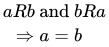 |  |  |  |  |  |  |  |
|
Y indicates that the column's property is always true for the row's term (at the very left), while ✗ indicates that the property is not guaranteed
in general (it might, or might not, hold). For example, that every equivalence relation is symmetric, but not necessarily antisymmetric,
is indicated by Y in the "Symmetric" column and ✗ in the "Antisymmetric" column, respectively.
All definitions tacitly require the homogeneous relation  be transitive: for all be transitive: for all  if if  and and  then then 
A term's definition may require additional properties that are not listed in this table.
|
In mathematics, an equivalence relation is a binary relation that is reflexive, symmetric, and transitive. The equipollence relation between line segments in geometry is a common example of an equivalence relation. A simpler example is numerical equality. Any number  is equal to itself (reflexive). If
  , then
  (symmetric). If and
  , then
  (transitive).
Each equivalence relation provides a partition of the underlying set into disjoint equivalence classes. Two elements of the given set are equivalent to each other if and only if they belong to the same equivalence class.