Mortal Kombat (1992 video game)
| Mortal Kombat | |
|---|---|
Cover artwork for the home versions | |
| Developer(s) | Midway Probe Software (GEN/MD, GG, GB, SMS, Amiga, DOS) Sculptured Software (SNES) |
| Publisher(s) | |
| Designer(s) | Ed Boon John Tobias |
| Programmer(s) | Ed Boon |
| Artist(s) | John Tobias John Vogel |
| Composer(s) | Dan Forden |
| Series | Mortal Kombat |
| Platform(s) |
|
| Release | |
| Genre(s) | Fighting |
| Mode(s) | Single-player, multiplayer |
| Arcade system | Midway Y Unit (Revision Prototype 4.0–Revision 4.0) Midway T Unit (Revision 4.0T–Revision 5.0T) |
Mortal Kombat is a 1992 fighting game developed and published by Midway. It is the first main installment in the Mortal Kombat franchise and was subsequently released by Acclaim Entertainment for nearly every home platform at that time. The game presents a martial arts tournament in which ten characters (including a choice of seven player characters) contend with the fate of Earth at stake. It introduced many key aspects of the Mortal Kombat series, including the unique five-button control scheme and gory finishing moves called Fatalities.
Mortal Kombat is considered by critics to be one of the greatest video games ever made. It spawned numerous sequels and spin-offs, beginning with Mortal Kombat II in 1993. Both games were the subject of a film adaptation in 1995. However, it also sparked much controversy for its depiction of extreme violence and gore using realistic digitized graphics and, along with the home releases of Night Trap and Lethal Enforcers, prompted the formation of the Entertainment Software Rating Board (ESRB), a U.S. government-backed organization that set descriptor ratings for video games.
- ^ Griest, Stephanie (August 28, 1995). "Mortal Kombat's' Bloodless Coup". The Washington Post. Retrieved October 11, 2022.
- ^ "PREPARE YOURSELF MORTAL MONDAY SEPTEMBER 13". GamePro. No. 50. IDG. September 1993. p. 5.
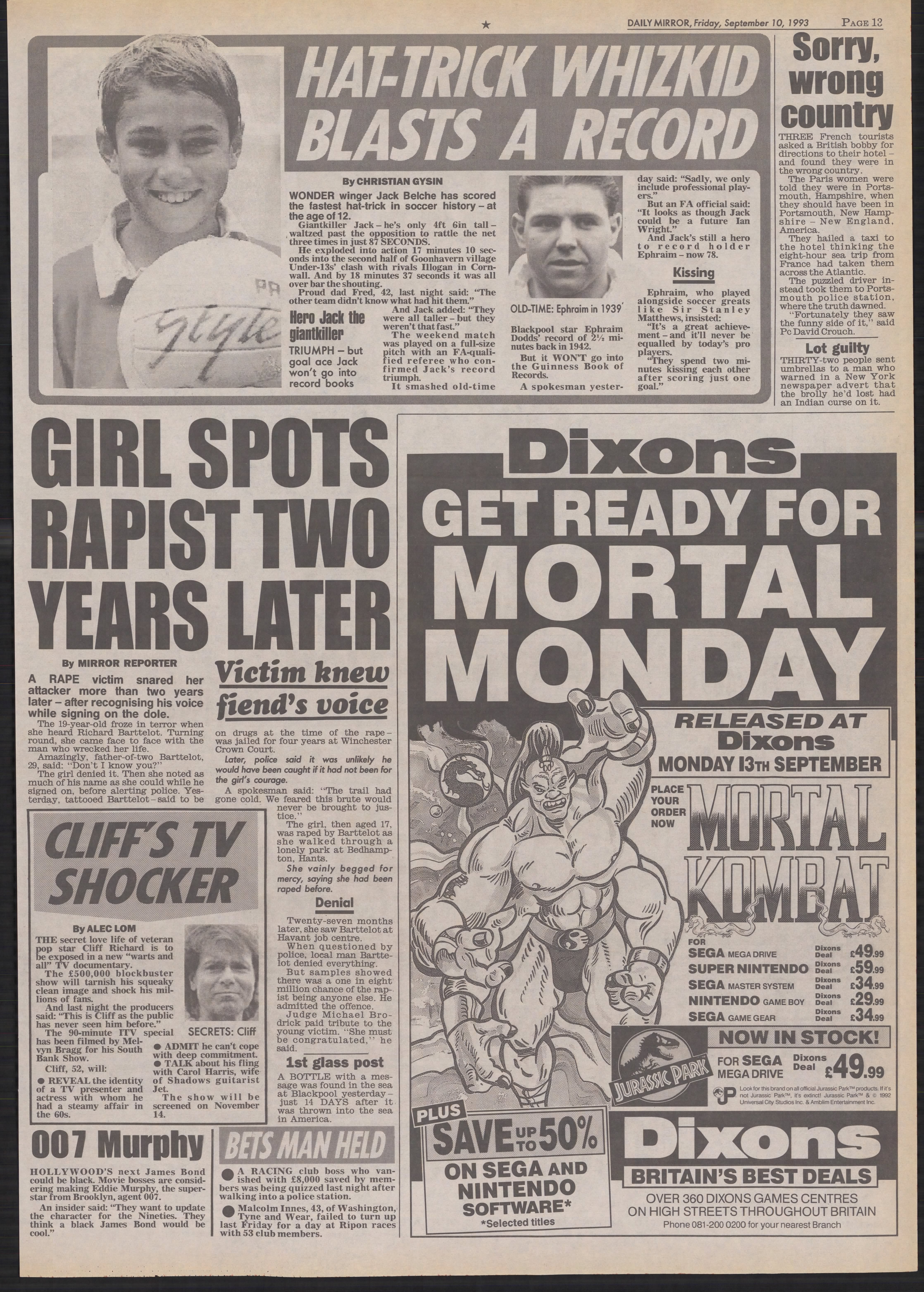
- ^ a b "Dixons Get Ready for Mortal Monday". Daily Mirror. September 10, 1993. Retrieved October 6, 2024.
- ^ "Mega-CD Review: Mortal Kombat". Mean Machines Sega. No. 20. EMAP. June 1994. pp. 74–75.
- ^ "Fact File". Electronic Gaming Monthly. No. 58. Sendai Publications. May 1994. p. 177.
Cite error: There are <ref group=lower-alpha> tags or {{efn}} templates on this page, but the references will not show without a {{reflist|group=lower-alpha}} template or {{notelist}} template (see the help page).