Many-worlds interpretation
| Part of a series of articles about |
| Quantum mechanics |
|---|
|
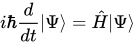
The many-worlds interpretation (MWI) is an interpretation of quantum mechanics that asserts that the universal wavefunction is objectively real, and that there is no wave function collapse.[1] This implies that all possible outcomes of quantum measurements are physically realized in different "worlds".[2] The evolution of reality as a whole in MWI is rigidly deterministic[1]: 9 and local.[3] Many-worlds is also called the relative state formulation or the Everett interpretation, after physicist Hugh Everett, who first proposed it in 1957.[4][5] Bryce DeWitt popularized the formulation and named it many-worlds in the 1970s.[6][1][7][8]
In modern versions of many-worlds, the subjective appearance of wave function collapse is explained by the mechanism of quantum decoherence.[2] Decoherence approaches to interpreting quantum theory have been widely explored and developed since the 1970s.[9][10][11] MWI is considered a mainstream interpretation of quantum mechanics, along with the other decoherence interpretations, the Copenhagen interpretation, and hidden variable theories such as Bohmian mechanics.[12][2]
The many-worlds interpretation implies that there are many parallel, non-interacting worlds. It is one of a number of multiverse hypotheses in physics and philosophy. MWI views time as a many-branched tree, wherein every possible quantum outcome is realized. This is intended to resolve the measurement problem and thus some paradoxes of quantum theory, such as Wigner's friend,[4]: 4–6 the EPR paradox[5]: 462 [1]: 118 and Schrödinger's cat,[6] since every possible outcome of a quantum event exists in its own world.
- ^ a b c d Everett, Hugh; Wheeler, J. A.; DeWitt, B. S.; Cooper, L. N.; Van Vechten, D.; Graham, N. (1973). DeWitt, Bryce; Graham, R. Neill (eds.). The Many-Worlds Interpretation of Quantum Mechanics. Princeton Series in Physics. Princeton, New Jersey: Princeton University Press. p. v. ISBN 0-691-08131-X.
- ^ a b c Tegmark, Max (1998). "The Interpretation of Quantum Mechanics: Many Worlds or Many Words?". Fortschritte der Physik. 46 (6–8): 855–862. arXiv:quant-ph/9709032. Bibcode:1998ForPh..46..855T. doi:10.1002/(SICI)1521-3978(199811)46:6/8<855::AID-PROP855>3.0.CO;2-Q. S2CID 212466.
- ^ Brown, Harvey R.; Christopher G. Timpson (2016). "Bell on Bell's Theorem: The Changing Face of Nonlocality". In Mary Bell; Shan Gao (eds.). Quantum Nonlocality and Reality: 50 years of Bell's theorem. Cambridge University Press. pp. 91–123. arXiv:1501.03521. doi:10.1017/CBO9781316219393.008. ISBN 9781316219393. S2CID 118686956.
On locality:"Amongst those who have taken Everett's approach to quantum theory at all seriously as an option, it is a commonplace that—given an Everettian interpretation—quantum theory is (dynamically) local-there is no action-at-a-distance" on determinism:"But zooming-out (in a God's-eye view) from a particular branch will be seen all the other branches, each with a different result of measurement being recorded and observed, all coexisting equally; and all underpinned by (supervenient on) the deterministically, unitarily, evolving universal wavefunction"
- ^ a b Hugh Everett Theory of the Universal Wavefunction, Thesis, Princeton University, (1956, 1973), pp. 1–140.
- ^ a b Everett, Hugh (1957). "Relative State Formulation of Quantum Mechanics". Reviews of Modern Physics. 29 (3): 454–462. Bibcode:1957RvMP...29..454E. doi:10.1103/RevModPhys.29.454. Archived from the original on 2011-10-27. Retrieved 2011-10-24.
- ^ a b DeWitt, Bryce S. (1970). "Quantum mechanics and reality". Physics Today. 23 (9): 30–35. Bibcode:1970PhT....23i..30D. doi:10.1063/1.3022331. See also Ballentine, Leslie E.; Pearle, Philip; Walker, Evan Harris; Sachs, Mendel; Koga, Toyoki; Gerver, Joseph; DeWitt, Bryce (1971). "Quantum-mechanics debate". Physics Today. 24 (4): 36–44. Bibcode:1971PhT....24d..36.. doi:10.1063/1.3022676.
- ^ Cecile M. DeWitt, John A. Wheeler (eds,) The Everett–Wheeler Interpretation of Quantum Mechanics, Battelle Rencontres: 1967 Lectures in Mathematics and Physics (1968).
- ^ Bryce Seligman DeWitt, The Many-Universes Interpretation of Quantum Mechanics, Proceedings of the International School of Physics "Enrico Fermi" Course IL: Foundations of Quantum Mechanics, Academic Press (1972).
- ^ H. Dieter Zeh, On the Interpretation of Measurement in Quantum Theory, Foundations of Physics, vol. 1, pp. 69–76, (1970).
- ^ Wojciech Hubert Zurek, Decoherence and the transition from quantum to classical, Physics Today, vol. 44, issue 10, pp. 36–44, (1991).
- ^ Wojciech Hubert Zurek, Decoherence, einselection, and the quantum origins of the classical, Reviews of Modern Physics, 75, pp. 715–775, (2003).
- ^ Schlosshauer, Maximilian; Kofler, Johannes; Zeilinger, Anton (August 2013). "A snapshot of foundational attitudes toward quantum mechanics". Studies in History and Philosophy of Science Part B: Studies in History and Philosophy of Modern Physics. 44 (3): 222–230. arXiv:1301.1069. Bibcode:2013SHPMP..44..222S. doi:10.1016/j.shpsb.2013.04.004.