Exponential distribution
| Exponential | |||
|---|---|---|---|
|
Probability density function | |||
|
Cumulative distribution function | |||
| Parameters | rate, or inverse scale | ||
| Support | |||
| CDF | |||
| Quantile | |||
| Mean | |||
| Median | |||
| Mode | |||
| Variance | |||
| Skewness | |||
| Excess kurtosis | |||
| Entropy | |||
| MGF | |||
| CF | |||
| Fisher information | |||
| Kullback–Leibler divergence | |||
| Expected shortfall | |||


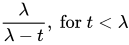

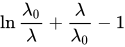
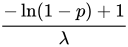
In probability theory and statistics, the exponential distribution or negative exponential distribution is the probability distribution of the distance between events in a Poisson point process, i.e., a process in which events occur continuously and independently at a constant average rate; the distance parameter could be any meaningful mono-dimensional measure of the process, such as time between production errors, or length along a roll of fabric in the weaving manufacturing process.[1] It is a particular case of the gamma distribution. It is the continuous analogue of the geometric distribution, and it has the key property of being memoryless.[2] In addition to being used for the analysis of Poisson point processes it is found in various other contexts.[3]
The exponential distribution is not the same as the class of exponential families of distributions. This is a large class of probability distributions that includes the exponential distribution as one of its members, but also includes many other distributions, like the normal, binomial, gamma, and Poisson distributions.[3]
- ^ "7.2: Exponential Distribution". Statistics LibreTexts. 2021-07-15. Retrieved 2024-10-11.
- ^ "Exponential distribution | mathematics | Britannica". www.britannica.com. Retrieved 2024-10-11.
- ^ a b Weisstein, Eric W. "Exponential Distribution". mathworld.wolfram.com. Retrieved 2024-10-11.