Poisson distribution
| Poisson distribution | |||
|---|---|---|---|
|
Probability mass function The horizontal axis is the index k, the number of occurrences. λ is the expected rate of occurrences. The vertical axis is the probability of k occurrences given λ. The function is defined only at integer values of k; the connecting lines are only guides for the eye. | |||
|
Cumulative distribution function The horizontal axis is the index k, the number of occurrences. The CDF is discontinuous at the integers of k and flat everywhere else because a variable that is Poisson distributed takes on only integer values. | |||
| Notation | |||
| Parameters | (rate) | ||
| Support | (Natural numbers starting from 0) | ||
| PMF | |||
| CDF |
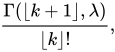
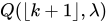
or or (for where is the upper incomplete gamma function, is the floor function, and is the regularized gamma function) | ||
| Mean | |||
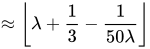
| Median | |||
| Mode | |||
| Variance | |||
| Skewness | |||
| Excess kurtosis | |||
| Entropy |
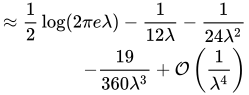
or for large | ||
| MGF | |||
| CF | |||
| PGF | |||
| Fisher information | |||







![{\displaystyle \lambda {\Bigl [}1-\log(\lambda ){\Bigr ]}+e^{-\lambda }\sum _{k=0}^{\infty }{\frac {\lambda ^{k}\log(k!)}{k!}}}](./64c5bb5a142a1b60e4a04c725d686557fdb238bc.svg)
![{\displaystyle \exp \left[\lambda \left(e^{t}-1\right)\right]}](./72c1560d02e57d6d1f2a6223fa16061ad399bb3a.svg)
![{\displaystyle \exp \left[\lambda \left(e^{it}-1\right)\right]}](./f2d912f7d931127ba7a6d044105a647ea4590b40.svg)
![{\displaystyle \exp \left[\lambda \left(z-1\right)\right]}](./b112607a91ffced05b02706979ee6651a6db3c84.svg)
In probability theory and statistics, the Poisson distribution (/ˈpwɑːsɒn/) is a discrete probability distribution that expresses the probability of a given number of events occurring in a fixed interval of time if these events occur with a known constant mean rate and independently of the time since the last event.[1] It can also be used for the number of events in other types of intervals than time, and in dimension greater than 1 (e.g., number of events in a given area or volume). The Poisson distribution is named after French mathematician Siméon Denis Poisson. It plays an important role for discrete-stable distributions.
Under a Poisson distribution with the expectation of λ events in a given interval, the probability of k events in the same interval is:[2]: 60 For instance, consider a call center which receives an average of λ = 3 calls per minute at all times of day. If the number of calls received in any two given disjoint time intervals is independent, then the number k of calls received during any minute has a Poisson probability distribution. Receiving k = 1 to 4 calls then has a probability of about 0.77, while receiving 0 or at least 5 calls has a probability of about 0.23.
A classic example used to motivate the Poisson distribution is the number of radioactive decay events during a fixed observation period.[3]