Taiwan
Republic of China | |
|---|---|
Emblem
| |
| Anthem: 中華民國國歌 "National Anthem of the Republic of China" Flag anthem: 中華民國國旗歌 "National Flag Anthem of the Republic of China" | |
| Capital | Taipei[a][2] 25°04′N 121°31′E / 25.067°N 121.517°E |
| Largest city | New Taipei City |
| Official languages | Standard Chinese[b][5][6][7] |
| Official script | Traditional Chinese[8] |
| National languages[c] | |
| Ethnic groups (2024)[12] |
|
| Religion (2020)[13] |
|
| Demonym(s) | Taiwanese[14] |
| Government | Unitary semi-presidential republic[15][16] |
| Lai Ching-te | |
• Vice President | Hsiao Bi-khim |
• Executive Yuan President / Premier | Cho Jung-tai |
• Legislative Yuan President | Han Kuo-yu |
• Judicial Yuan President / Chief Justice | Shieh Ming-yan (acting) |
| Legislature | Legislative Yuan[g] |
| Establishment | |
• Qing rule | 1683 |
• Japanese rule | 17 April 1895 |
• ROC rule | 25 October 1945 |
• Retreat of ROC to Taiwan | 7 December 1949 |
| Area | |
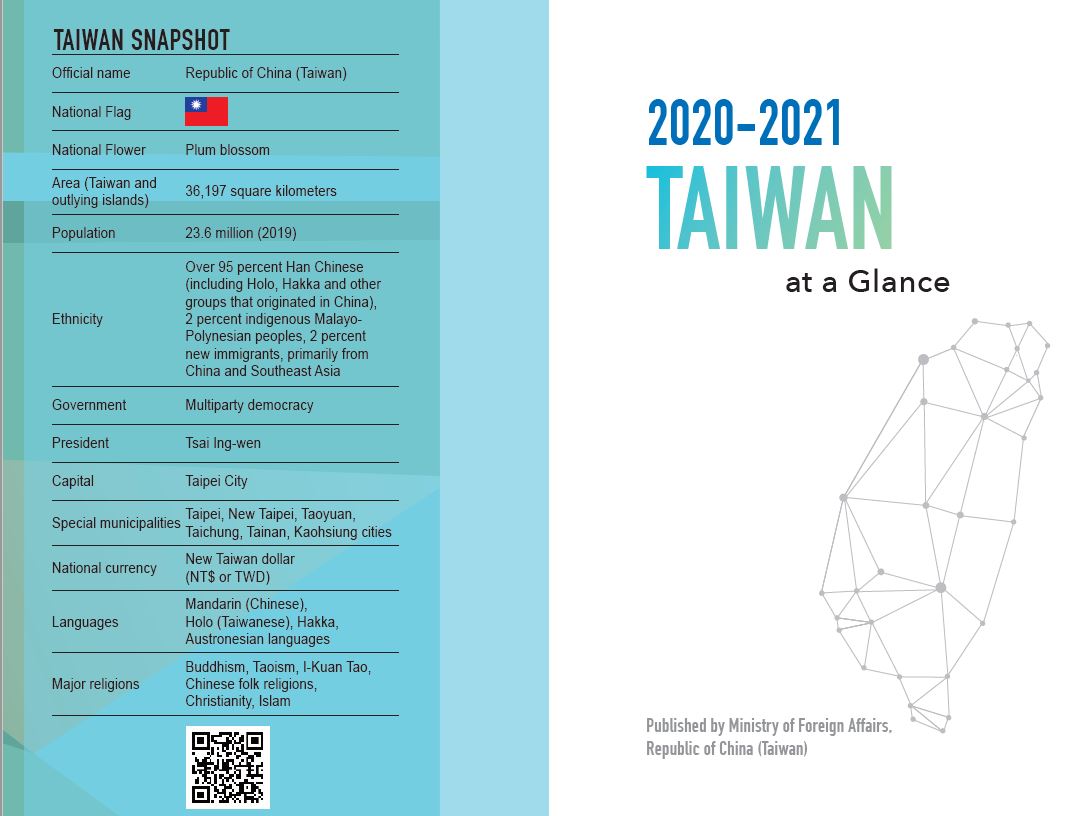
• Total | 36,197 km2 (13,976 sq mi)[17][14] |
| Population | |
• January 2025 estimate | 23,396,049[18] (59th) |
• 2020 census | 23,829,897[19] |
• Density | 646/km2 (1,673.1/sq mi) (17th) |
| GDP (PPP) | 2025 estimate |
• Total | $1.966 trillion[20] (20th) |
• Per capita | $84,082[20] (11th) |
| GDP (nominal) | 2025 estimate |
• Total | $805 billion[20] (21st) |
• Per capita | $34,426[20] (30th) |
| Gini (2022) | 34.2[21] medium inequality |
| HDI (2021) | 0.926[h][22] very high (19th) |
| Currency | New Taiwan dollar (NT$) (TWD) |
| Time zone | UTC+8 (National Standard Time) |
| ISO 3166 code | TW |
| Internet TLD | .tw, .台灣, .台湾[23] |
Taiwan,[II][i] officially the Republic of China (ROC),[I] is a country[27] in East Asia.[l] The main island of Taiwan, also known as Formosa, lies between the East and South China Seas in the northwestern Pacific Ocean, with the People's Republic of China (PRC) to the northwest, Japan to the northeast, and the Philippines to the south. It has an area of 35,808 square kilometres (13,826 square miles), with mountain ranges dominating the eastern two-thirds and plains in the western third, where its highly urbanized population is concentrated. The combined territories under ROC control consist of 168 islands[m] in total covering 36,193 square kilometres (13,974 square miles).[17][39] The largest metropolitan area is formed by Taipei (the capital), New Taipei City, and Keelung. With around 23.9 million inhabitants, Taiwan is among the most densely populated countries.
Taiwan has been settled for at least 25,000 years. Ancestors of Taiwanese indigenous peoples settled the island around 6,000 years ago. In the 17th century, large-scale Han Chinese immigration began under Dutch colonial rule and continued under the Kingdom of Tungning, the first predominantly Han Chinese state in Taiwanese history. The island was annexed in 1683 by the Qing dynasty and ceded to the Empire of Japan in 1895. The Republic of China, which had overthrown the Qing in 1912 under the leadership of Sun Yat-sen, assumed control following the surrender of Japan in World War II. But with the loss of mainland China to the Communists in the Chinese Civil War, the government moved to Taiwan in 1949 under the Kuomintang (KMT).
From the early 1960s, Taiwan saw rapid economic growth and industrialization known as the "Taiwan Miracle".[40] In the late 1980s and early 1990s, the ROC transitioned from a one-party state under martial law to a multi-party democracy, with democratically elected presidents beginning in 1996. Taiwan's export-oriented economy is the 21st-largest in the world by nominal GDP and the 20th-largest by PPP measures, with a focus on steel, machinery, electronics, and chemicals manufacturing. Taiwan is a developed country.[41][42] It is ranked highly in terms of civil liberties,[43] healthcare,[44] and human development.[h][22]
The political status of Taiwan is contentious. Despite being a founding member, the ROC no longer represents China as a member of the United Nations after UN members voted in 1971 to recognize the PRC instead. The ROC maintained its claim to be the sole legitimate representative of China and its territory until 1991, when it ceased to regard the Chinese Communist Party as a rebellious group and acknowledged its control over mainland China. Taiwan is claimed by the PRC, which refuses to establish diplomatic relations with countries that recognise the ROC. Taiwan maintains official diplomatic relations with 11 out of 193 UN member states and the Holy See. Many others maintain unofficial diplomatic ties through representative offices and institutions that function as de facto embassies and consulates. International organizations in which the PRC participates either refuse to grant membership to Taiwan or allow it to participate on a non-state basis. Domestically, the major political contention is between the Pan-Blue Coalition, who favors eventual Chinese unification under the ROC and promoting a pan-Chinese identity, contrasted with the Pan-Green Coalition, which favors eventual Taiwanese independence and promoting a Taiwanese identity; in the 21st century, both sides have moderated their positions to broaden their appeal.[49][50]
Cite error: There are <ref group=upper-roman> tags on this page, but the references will not show without a {{reflist|group=upper-roman}} template (see the help page).
- ^ "Since the implementation of the Act Governing Principles for Editing Geographical Educational Texts (地理敎科書編審原則) in 1997, the guiding principle for all maps in geographical textbooks was that Taipei was to be marked as the capital with a label stating: "Location of the Central Government"". 4 December 2013. Archived from the original on 1 November 2019.
- ^ "Interior minister reaffirms Taipei is ROC's capital". Taipei Times. 5 December 2013. Archived from the original on 14 April 2019. Retrieved 7 December 2013.
- ^ "推動雙語國家政策問題研析". ly.gov.tw (in Chinese). 23 July 2013. Archived from the original on 1 June 2022. Retrieved 2 June 2021.
- ^ "法律統一用語表-常見公文用語說明" (PDF) (in Chinese). Archived from the original (PDF) on 2 June 2021. Retrieved 2 June 2021.
- ^ "Chapter 2: People and Language". The Republic of China Yearbook 2012. Government Information Office. 2012. p. 24. ISBN 978-986-03-4590-2. Archived from the original on 14 October 2013. Retrieved 18 December 2013.
- ^ Government Information Office (2010). "Chapter 2: People and Language" (PDF). The Republic of China Yearbook 2010. 中華民國政府出版品. p. 42. ISBN 978-986-02-5278-1. Archived from the original (PDF) on 5 August 2011.
- ^ Liao, Silvie (2008). "A Perceptual Dialect Study of Taiwan Mandarin: Language Attitudes in the Era of Political Battle". In Chan, Marjorie K. M.; Kang, Hana (eds.). Proceedings of the 20th North American Conference on Chinese Linguistics (NACCL-20) (PDF). Vol. 1. The Ohio State University. p. 393. ISBN 978-0-9824715-0-0. Archived from the original (PDF) on 24 December 2013.
- ^ "行政院第3251次院會決議". ey.gov.tw (in Chinese). December 2011. Archived from the original on 25 May 2021. Retrieved 25 May 2021.
- ^ 國家語言發展法. law.moj.gov.tw (in Chinese). Archived from the original on 11 November 2020. Retrieved 22 May 2019.
- ^ "Hakka Basic Act". law.moj.gov.tw. Archived from the original on 13 February 2019. Retrieved 22 May 2019.
- ^ "Indigenous Languages Development Act". law.moj.gov.tw. Archived from the original on 13 February 2019. Retrieved 22 May 2019.
- ^ 2024–2025 Taiwan at a Glance (PDF). Ministry of Foreign Affairs, ROC (Taiwan). 2024. pp. 15–17. ISBN 978-986-5447-77-9. Retrieved 15 July 2025.
- ^ "Religious Composition by Country, 2010–2050". Pew Research Center's Religion & Public Life Project. 2 April 2015. Archived from the original on 21 December 2019.
- ^ a b Cite error: The named reference
cia-factbookwas invoked but never defined (see the help page). - ^ Kucera, Ondrej (1 July 2006). "Is Taiwan a Presidential System?". China Perspectives (in French). 2006 (4). doi:10.4000/chinaperspectives.1036. ISSN 1996-4617. S2CID 152497908.
- ^ "Taiwan - Chiang Kai-shek's Government, Democratization, and Constitutional Reforms". Britannica. Archived from the original on 19 June 2023. Retrieved 19 June 2023.
- ^ a b "TAIWAN SNAPSHOT". Archived from the original on 15 March 2020. Retrieved 15 March 2020.
- ^ "Household registration statistics data analysis in Jan 2025". Dept. of Household Registration, Ministry of the Interior. 10 February 2025. Retrieved 2 April 2025.
- ^ "2020 Statistical Tables". National Statistics, ROC (Taiwan). 17 May 2023. Retrieved 2 April 2025.
- ^ a b c d "World Economic Outlook Database, April 2025 Edition (Taiwan)". International Monetary Fund. 16 April 2025. Retrieved 31 May 2025.
- ^ "Table 4. Percentage Share of Disposable Income by Quintile Group of Households and Income Inequality Indices". Statistical Bureau. Retrieved 8 September 2024.
- ^ a b c "國情統計通報(第 195 號)" (PDF). Directorate General of Budget, Accounting and Statistics, Executive Yuan, Taiwan (ROC). 14 October 2021. Archived (PDF) from the original on 11 February 2023. Retrieved 11 February 2023.
- ^ "ICANN Board Meeting Minutes". ICANN. 25 June 2010. Archived from the original on 7 July 2010. Retrieved 25 June 2010.
- ^ "Laws and Regulations Regarding Mainland Affairs". mac.gov.tw. Mainland Affairs Council, Executive Yuan. 17 September 2020. Archived from the original on 28 September 2021. Retrieved 23 September 2021.
Article 2: The following terms as used in this Act are defined below.
1. 'Taiwan Area' refers to Taiwan, Penghu, Kinmen, Matsu, and any other area under the effective control of the Government. - ^ "Taiwan Relations Act". ait.org.tw. American Institute in Taiwan. 30 March 2022. Archived from the original on 19 August 2022. Retrieved 14 December 2022.
...Section. 15. For purposes of this Act- 2. the term 'Taiwan' includes, as the context may require, the islands of Taiwan and the Pescadores (Penghu).
- ^ "Geography". Penghu County Government. Archived from the original on 9 December 2022. Retrieved 14 December 2022.
Penghu locates on the Taiwan Strait between China and Taiwan in Asia. It is the only island county of Taiwan... The utmost west isle (of Penghu) is also the utmost west boundary of Taiwan.
- ^ Multiple sources:
- Kort, Michael (2005). The Handbook Of East Asia. Lerner Publishing Group. p. 7. ISBN 978-0-7613-2672-4. Retrieved 26 June 2022.
South Korea is another emerging economic powerhouse, as is the Republic of China (ROC), a small country that occupies the island of Taiwan in the shadow of its enormous and hostile mainland neighbor, the PRC.
- Fell, Dafydd (2018). Government and Politics in Taiwan. Routledge. p. 305. ISBN 978-1-317-28506-9.
Moreover, its status as a vibrant democratic state has earned it huge international sympathy and a generally positive image.
- Campbell, Matthew (7 January 2020). "China's Next Crisis Brews in Taiwan's Upcoming Election". Bloomberg Businessweek. No. 4642. pp. 34–39. Archived from the original on 24 September 2020. Retrieved 24 September 2020.
Much has changed in Taiwan since Chiang's day, but this liminal quality has never really gone away. By almost any functional standard, it's a sovereign country
- Carolan, Christopher (May 2000). "The 'Republic of Taiwan': Legal-Historical Justification for a Taiwanese Declaration of Independence" (PDF). New York University Law Review. 75 (2): 429–468. Archived (PDF) from the original on 25 March 2022. Retrieved 17 March 2022.
These six criteria demonstrate that under international law Taiwan merits recognition as an independent state and as such is already a de facto state.
- Zagoria, Donald S. (30 October 2003). Breaking the China-Taiwan Impasse. ABC-CLIO. pp. 68–. ISBN 978-0-313-05755-7. OCLC 1058389524.
Taiwan possesses all of the elements of a sovereign state: a legitimate government, population, and a well-defined territory. The fact is that the People's Republic of China (PRC), while claiming sovereignty over Taiwan, has never ruled Taiwan since the PRC's establishment in 1949. Thus, Taiwan is in fact a sovereign country from our perspective.
- Kort, Michael (2005). The Handbook Of East Asia. Lerner Publishing Group. p. 7. ISBN 978-0-7613-2672-4. Retrieved 26 June 2022.
- ^ Bellwood, Peter S. (2017). First islanders: prehistory and human migration in Island Southeast Asia (First ed.). Wiley Blackwell. ISBN 9781119251552.
- ^ "國情簡介-土地" [Country profile-Territories] (in Chinese (Taiwan)). Executive Yuan. 2022. Archived from the original on 4 March 2022.
臺灣本島及其21個附屬島嶼面積共3萬5886.8623平方公里.
[The main island of Taiwan and its 21 associated islands have a total area of 35,886.8623 square kilometers.] - ^ "Measure of the area". Penghu County Government. 2022. Archived from the original on 28 December 2021. Retrieved 9 March 2022.
- ^ "澎湖縣各行政區域島嶼簡介" (in Chinese (Taiwan)). Kun Shan University. 2022. Archived from the original on 1 July 2020.
澎湖群島原為64個島嶼組成, 經2005年澎湖縣政府重新進行澎湖群島島嶼數量清查, 係由90座大小島嶼所組成.
[The Penghu Archipelago was conventionally considered to comprise 64 islands. In 2005, the Penghu County Government re-scrutinized the total number of islands in the archipelago, which consists of 90 islands of varying sizes.] - ^ "自然環境" [Natural Environment] (PDF). 金門縣第四期(104–107年)離島綜合建設實施方案 (in Chinese (Taiwan)). National Development Council, Executive Yuan: 44. 23 December 2014. Archived (PDF) from the original on 19 March 2022. Retrieved 10 March 2022.
金門縣總面積151平方公里, 除大金門本島外, 尚包括小金門、大膽、二膽、東碇、北碇等17個島嶼.西距廈門外港約10海浬, 東距臺灣約150海浬, 為一典型大陸型島嶼.
[The total area of Kinmen County is 151 square kilometers. In addition to the main island of Kinmen, the county also includes Xiaokinmen, Dadan, Erdan, Dongding and Beiding for a total of 17 islands. It is about 10 nautical miles away from the Port of Xiamen to the west and 150 nautical miles away from Taiwan to the east. It is a typical continental island.] - ^ "About Kinmen". Kinmen County Government. 8 December 2017. Archived from the original on 2 March 2022.
- ^ "金門的地理與歷史概說" [The overview of geography and history of Kinmen] (PDF). 第四章 金門的地理、歷史與總體經濟分析 (in Chinese (Taiwan)). National Taiwan Normal University: 131–134. 20 February 2006. Archived (PDF) from the original on 25 March 2022. Retrieved 10 March 2022.
- ^ Guy Plopsky (22 February 2017). "Taiwan's Cold War Fortresses". The Diplomat. Archived from the original on 16 April 2021. Retrieved 9 March 2022.
- ^ "連江縣志 地理志" (in Chinese (Taiwan)). 馬祖資訊網. 12 May 2011. Archived from the original on 19 March 2022. Retrieved 9 March 2022.
馬祖列島所涵括的36座島嶼分屬四鄉, 各鄉除了包括有聚落發展的較大島嶼外, 還轄有數座無人島礁.
[Matsu islands encompass 36 Islands which are divided into four townships. In addition to the larger islands with inhabitants, each township also has numerous uninhabited islands and reefs] - ^ Lung Tsun-Ni (龍村倪) (1998). 東沙群島-東沙島紀事集錦 (in Chinese (Taiwan)). 臺灣綜合研究院. p. 13. ISBN 957-98189-0-8. Archived from the original on 30 January 2009.
東沙島為東沙群島唯一島嶼
[Pratas Island is the only island in the Pratas Islands] - ^ "Limits in the Seas – No. 127 Taiwan's Maritime Claims" (PDF). United States Department of State. 15 November 2005. Archived (PDF) from the original on 15 July 2020.
The Pratas Reef lies 230 miles to the southwest of the southern tip of Taiwan. It consists of an island in the mouth of a semicircular shoal open to the west.
- ^ Economic Development R.O.C (Taiwan) (Report). National Development Council (Taiwan). p. 4. Archived from the original on 7 November 2021. Retrieved 6 November 2021.
- ^ Gold (1985).
- ^ World Bank Country and Lending Groups Archived 11 January 2018 at the Wayback Machine, World Bank. Retrieved 10 July 2018.
- ^ "IMF Advanced Economies List. World Economic Outlook, April 2016, p. 148" (PDF). Archived from the original (PDF) on 21 April 2016.
- ^ Keoni Everington (1 March 2024). "Taiwan rated 2nd freest in Asia by Freedom House, 7th in world". Taiwan News. Retrieved 15 May 2024.
- ^ Yao, Grace; Cheng, Yen-Pi; Cheng, Chiao-Pi (5 November 2008). "The Quality of Life in Taiwan". Social Indicators Research. 92 (2): 377–404. doi:10.1007/s11205-008-9353-1. S2CID 144780750.
a second place ranking in the 2000 Economist's world healthcare ranking
- ^ "Human Development Report 2020: Reader's Guide". United Nation Development Program. 2020. Archived from the original on 16 April 2021. Retrieved 12 March 2021.
- ^ "What is the human development index (HDI)? How are relevant data queried?" (PDF). Directorate General of Budget, Accounting and Statistics, Executive Yuan, Taiwan (ROC). Archived (PDF) from the original on 12 June 2021. Retrieved 14 March 2021.
- ^ "人類發展指數(Human Development Index, HDI)" (PDF) (in Chinese (Taiwan)). Directorate General of Budget, Accounting and Statistics, Executive Yuan, Taiwan (ROC). 6 January 2011. Archived from the original (PDF) on 14 April 2021.
- ^ "National Statistics, Republic of China (Taiwan)". Directorate General of Budget, Accounting and Statistics, Executive Yuan, Taiwan (ROC). 14 October 2022. Archived from the original on 16 October 2022. Retrieved 18 March 2018.
- ^ Fell, Dafydd (2006). Party Politics in Taiwan. Routledge. p. 85. ISBN 978-1-134-24021-0.
- ^ Achen, Christopher H.; Wang, T. Y. (2017). "The Taiwan Voter: An Introduction". In Achen, Christopher H.; Wang, T. Y. (eds.). The Taiwan Voter. University of Michigan Press. pp. 1–25. doi:10.3998/mpub.9375036. ISBN 978-0-472-07353-5. pp. 1–2.

Cite error: There are <ref group=lower-alpha> tags or {{efn}} templates on this page, but the references will not show without a {{reflist|group=lower-alpha}} template or {{notelist}} template (see the help page).