Logical conjunction
| AND | |
|---|---|
| Definition | |
| Truth table | |
| Logic gate | |
| Normal forms | |
| Disjunctive | |
| Conjunctive | |
| Zhegalkin polynomial | |
| Post's lattices | |
| 0-preserving | yes |
| 1-preserving | yes |
| Monotone | yes |
| Affine | no |
| Self-dual | no |


| Logical connectives | ||||||||||||||||||||||||||
|---|---|---|---|---|---|---|---|---|---|---|---|---|---|---|---|---|---|---|---|---|---|---|---|---|---|---|
|
||||||||||||||||||||||||||
| Related concepts | ||||||||||||||||||||||||||
|
||||||||||||||||||||||||||
| Applications | ||||||||||||||||||||||||||
|
||||||||||||||||||||||||||
| Category |
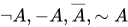




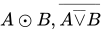

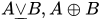





In logic, mathematics and linguistics, and () is the truth-functional operator of conjunction or logical conjunction. The logical connective of this operator is typically represented as [1] or or (prefix) or or [2] in which is the most modern and widely used.


The and of a set of operands is true if and only if all of its operands are true, i.e., is true if and only if is true and is true.


An operand of a conjunction is a conjunct.[3]
Beyond logic, the term "conjunction" also refers to similar concepts in other fields:
- In natural language, the denotation of expressions such as English "and";
- In programming languages, the short-circuit and control structure;
- In set theory, intersection.
- In lattice theory, logical conjunction (greatest lower bound).
- ^ "2.2: Conjunctions and Disjunctions". Mathematics LibreTexts. 2019-08-13. Retrieved 2020-09-02.
- ^ "Conjunction, Negation, and Disjunction". philosophy.lander.edu. Retrieved 2020-09-02.
- ^ Beall, Jeffrey C. (2010). Logic: the basics (1. publ ed.). London: Routledge. p. 17. ISBN 978-0-203-85155-5.