Log-normal distribution
| Log-normal distribution | |||
|---|---|---|---|
|
Probability density function Identical parameter but differing parameters | |||
|
Cumulative distribution function | |||
| Notation | |||
| Parameters |
| ||
| Support | |||
| CDF | |||
| Quantile | |||
| Mean | |||
| Median | |||
| Mode | |||
| Variance | |||
| Skewness | |||
| Excess kurtosis | |||
| Entropy | |||
| MGF | defined only for numbers with a non-positive real part, see text | ||
| CF | representation is asymptotically divergent, but adequate for most numerical purposes | ||
| Fisher information | |||
| Method of moments |
| ||
| Expected shortfall | [1] | ||






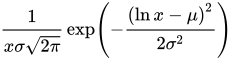
![{\displaystyle {\begin{aligned}&{\frac {1}{2}}\left[1+\operatorname {erf} \left({\frac {\ln x-\mu }{\sigma {\sqrt {2}}}}\right)\right]\\[1ex]&=\Phi {\left({\frac {\ln x-\mu }{\sigma }}\right)}\end{aligned}}}](./9d618b98b8568d6739c0b7dd44461a82af67e684.svg)
![{\displaystyle {\begin{aligned}&\exp \left(\mu +{\sqrt {2\sigma ^{2}}}\operatorname {erf} ^{-1}(2p-1)\right)\\[1ex]&=\exp(\mu +\sigma \Phi ^{-1}(p))\end{aligned}}}](./3c38543bce1e1e73df71172a85db777e64cc2c03.svg)
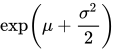


![{\displaystyle \left[\exp(\sigma ^{2})-1\right]\exp \left(2\mu +\sigma ^{2}\right)}](./5b2a3227efcf3f58f8dab62dd3c74f12a5915dfa.svg)
![{\displaystyle \left[\exp \left(\sigma ^{2}\right)+2\right]{\sqrt {\exp(\sigma ^{2})-1}}}](./98011e63b13d327830c8ddc50149b7a24939454b.svg)

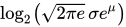
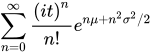

![{\displaystyle \mu =\ln \operatorname {E} [X]-{\frac {1}{2}}\ln \left({\frac {\operatorname {Var} [X]}{\operatorname {E} [X]^{2}}}+1\right),}](./b9798fd85526f3fb18f5fc07a1aa9350b5ab9bd6.svg)
![{\displaystyle \sigma ={\sqrt {\ln \left({\frac {\operatorname {Var} [X]}{\operatorname {E} [X]^{2}}}+1\right)}}}](./5e674d7a8e3b7455d058ea4a5f0b84167feb27d6.svg)
![{\displaystyle {\begin{aligned}&{\frac {e^{\mu +{\frac {\sigma ^{2}}{2}}}}{2p}}\left[1+\operatorname {erf} \left({\frac {\sigma }{\sqrt {2}}}+\operatorname {erf} ^{-1}(2p-1)\right)\right]\\[0.5ex]&={\frac {e^{\mu +{\frac {\sigma ^{2}}{2}}}}{1-p}}\left[1-\Phi (\Phi ^{-1}(p)-\sigma )\right]\end{aligned}}}](./5d417fca92c199af09fcd9e9c9db98e332116c7f.svg)
In probability theory, a log-normal (or lognormal) distribution is a continuous probability distribution of a random variable whose logarithm is normally distributed. Thus, if the random variable X is log-normally distributed, then Y = ln X has a normal distribution.[2][3] Equivalently, if Y has a normal distribution, then the exponential function of Y, X = exp(Y), has a log-normal distribution. A random variable which is log-normally distributed takes only positive real values. It is a convenient and useful model for measurements in exact and engineering sciences, as well as medicine, economics and other topics (e.g., energies, concentrations, lengths, prices of financial instruments, and other metrics).
The distribution is occasionally referred to as the Galton distribution or Galton's distribution, after Francis Galton.[4] The log-normal distribution has also been associated with other names, such as McAlister, Gibrat and Cobb–Douglas.[4]
A log-normal process is the statistical realization of the multiplicative product of many independent random variables, each of which is positive. This is justified by considering the central limit theorem in the log domain (sometimes called Gibrat's law). The log-normal distribution is the maximum entropy probability distribution for a random variate X—for which the mean and variance of ln X are specified.[5]
- ^ Norton, Matthew; Khokhlov, Valentyn; Uryasev, Stan (2019). "Calculating CVaR and bPOE for common probability distributions with application to portfolio optimization and density estimation" (PDF). Annals of Operations Research. 299 (1–2). Springer: 1281–1315. arXiv:1811.11301. doi:10.1007/s10479-019-03373-1. S2CID 254231768. Archived (PDF) from the original on 2021-04-18. Retrieved 2023-02-27 – via stonybrook.edu.
- ^ Weisstein, Eric W. "Log Normal Distribution". mathworld.wolfram.com. Retrieved 2020-09-13.
- ^ "1.3.6.6.9. Lognormal Distribution". www.itl.nist.gov. U.S. National Institute of Standards and Technology (NIST). Retrieved 2020-09-13.
- ^ a b Cite error: The named reference
JKBwas invoked but never defined (see the help page). - ^ Park, Sung Y.; Bera, Anil K. (2009). "Maximum entropy autoregressive conditional heteroskedasticity model" (PDF). Journal of Econometrics. 150 (2): 219–230, esp. Table 1, p. 221. CiteSeerX 10.1.1.511.9750. doi:10.1016/j.jeconom.2008.12.014. Archived from the original (PDF) on 2016-03-07. Retrieved 2011-06-02.