| Hypergeometric |
|---|
|
Probability mass function |
|
Cumulative distribution function |
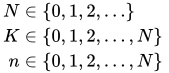
| Parameters |
 |
|---|
| Support |
 |
|---|
| PMF |
 |
|---|
| CDF |
![{\displaystyle 1-{{{n \choose {k+1}}{{N-n} \choose {K-k-1}}} \over {N \choose K}}\,_{3}F_{2}\!\!\left[{\begin{array}{c}1,\ k+1-K,\ k+1-n\\k+2,\ N+k+2-K-n\end{array}};1\right],}](./556153b7446bc4321c995b2d8f9cc2957a0df452.svg) where where  is the generalized hypergeometric function is the generalized hypergeometric function |
|---|
| Mean |
 |
|---|
| Mode |
 |
|---|
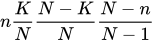
| Variance |
 |
|---|
| Skewness |
![{\displaystyle {\frac {(N-2K)(N-1)^{\frac {1}{2}}(N-2n)}{[nK(N-K)(N-n)]^{\frac {1}{2}}(N-2)}}}](./f9ec1b0c28225251fa3fd794e30bffc3eb34315e.svg) |
|---|
| Excess kurtosis |


![{\displaystyle {}+6nK(N-K)(N-n)(5N-6){\big ]}}](./873d966636267a7d676f2d26681eb7bcf1a2259b.svg) |
|---|
| MGF |
 |
|---|
| CF |
 |
|---|
In probability theory and statistics, the hypergeometric distribution is a discrete probability distribution that describes the probability of  successes (random draws for which the object drawn has a specified feature) in
  draws, without replacement, from a finite population of size
  that contains exactly
  objects with that feature, wherein each draw is either a success or a failure. In contrast, the binomial distribution describes the probability of successes in draws with replacement.