A sequence in a space  is a function
  . We write
  and denote the sequence by
  or simply
  . Intuitively, a sequence is an infinite list
  of points of .
Examples.
- In
 ,
,  is the list
  .
.
- The constant sequence
 repeats the point
  forever.
Convergence of sequences
Let  be a topological space and let
  be a sequence in . We say
  (or that converges to
  ) if for every neighborhood
  of there exists
  such that
  implies
  . Equivalently, the sequence is eventually in every neighborhood of .
Uniqueness of limits in Hausdorff spaces
Theorem. If is Hausdorff, a sequence of points of has at most one limit.
Proof. Suppose and  . Choose disjoint neighborhoods
  and
and  . Since
  is eventually in , it is not eventually in
  , so it cannot converge to
  . ∎
. ∎
Subsequences and cluster points
A subsequence is a sequence  with strictly increasing indices
  . If then every subsequence also converges to .
A point is a cluster point (or limit point) of if every neighborhood contains infinitely many terms of the sequence. In first-countable spaces (see below), is a cluster point of iff some subsequence converges to .
First countability and sequential closure
A space is first countable if each  has a countable neighborhood base
  with
with  . Metric spaces are first countable.
Theorem (Sequential characterization of closure in first-countable spaces).
If is first countable and  , then
 iff there exists a sequence in
  with
with  .
.
Proof. If , pick  from a nested countable neighborhood base
  at . Conversely, if , then every neighborhood of contains eventually all
  , hence meets .
When sequences are not enough (co-countable extension topology)
In this section we use the topology on having as base all sets of the form

where  is open in the usual Euclidean topology on and
  is countable. This is sometimes called the co-countable extension topology (it refines the usual topology by also including sets obtained by removing countably many points from usual opens). In particular, every usual open set remains open because
  is a basic open here. Hence this topology is finer than the usual one.
- A sequence converges to iff it is eventually constant at .
Proof. Suppose in this topology. Let

the (at most) countable set of values attained by the sequence that differ from . Then  is a basic open neighborhood of . By convergence, there is
  such that for all ,
  . But for any term of the sequence, either
  or
or  by definition of . Thus forces . Hence the sequence is eventually constant at .
Conversely, if for all , then for any neighborhood  we have
  for all , so .
![{\displaystyle {\overline {(0,1)}}=[0,1]}](../_assets_/eb734a37dd21ce173a46342d1cc64c92/7cf22c03293597a25431930dd641b18f9bcecfb8.svg) .
.
Proof. Because this topology is finer than the usual topology, every set that is closed in the usual topology is also closed here: if  with usual-open, then is still open in the refined topology, hence remains closed. In particular,
 ![{\displaystyle [0,1]}](../_assets_/eb734a37dd21ce173a46342d1cc64c92/738f7d23bb2d9642bab520020873cccbef49768d.svg) is closed, so the closure of
is closed, so the closure of  is contained in .
To see that  and lie in the closure, let
  and let be any neighborhood of in the refined topology. Choose a basic neighborhood
  with
with  , where is usual-open and is countable. Since every usual-open containing meets in an (uncountable) interval,
  . Thus
  , and therefore
  . Hence each of and is a closure point of , giving .
Nets
A directed set is a set  with a reflexive, transitive relation
  such that for any
  there exists
  with
with  and
and  (an upper bound). Examples:
 with the usual order;
 with
with  ;
;- the neighborhood system
 at a point , directed by reverse inclusion:
  ;
;
- finite-subset filter base: all finite
 directed by reverse inclusion
  .
.
Products of directed sets are directed by the product order.
A net in is a function  from a directed set . We write
  . A net converges to if for every neighborhood there exists
  such that
  implies
  .
.
Theorem.
Let be a topological space and . A point satisfies iff there exists a net  with each
  and
and  .
.
Proof.
( ) Assume . Let be the set of neighborhoods of , directed by reverse inclusion: . For each
  we have
  ; choose
  . Then
  is a net in . It converges to : given any neighborhood
  , for all
  we have
  , hence
  .
.
( ) Conversely, suppose is a net in with . If is any neighborhood of , then
  eventually, so
  . Hence every neighborhood of meets , i.e. . ∎
Remark (choice-free variant).
It can be noted that this result doesn't quite depend on the axiom of choice because we can avoid the selection by indexing by
 with
with  iff
iff  ; define the net
  . Then
  for the same reason as above. All the following theorems in the net section can be modified in a similar manner to avoid using choice, which can be an exercise.
Hausdorff uniqueness for nets
Theorem (Hausdorff ⇔ unique net limits).
A topological space is Hausdorff if and only if every net in converges to at most one point.
Proof.
() If is Hausdorff and a net converges to both and with  , choose disjoint neighborhoods and . Being eventually in and eventually in forces the net to be eventually in
  , impossible. Hence limits are unique.
() Suppose every net in has at most one limit, yet is not Hausdorff. Then there exist distinct points such that every neighborhood of meets every neighborhood of . Consider the directed sets and  of neighborhoods of and , ordered by reverse inclusion:
  . Their product
  is directed by
  .
.
For each  , choose a point
 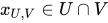 (nonempty by assumption). Then the net
 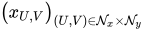 converges to (given a neighborhood
  , take
  for any V) and also to (symmetrically). This contradicts uniqueness of limits for nets. Therefore must be Hausdorff. ∎
Cluster points and subnets
We say is a cluster point (or limit point) of a net  if for every neighborhood and every
  there exists
  with
with  .
.
A net  is a subnet of if there exists a function
  such that:
 for all
  ; and
; and- for every there exists
 with
with  . (This is often described as the image of
  being cofinal in .)
Theorem (Cluster point ⇔ limit of a subnet).
Let be a net in a topological space and let . Then is a cluster point of if and only if there exists a subnet of that converges to .
Proof.
() Assume is a cluster point. Consider the directed set  , ordered by the product of the given order on and reverse inclusion on :

For each  , by the cluster property choose
  with
with  . Define

Then  is a subnet of : condition (1) is by definition; for (2), given take
 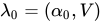 (any ); if
  , then , hence
  . Finally,
  : for any neighborhood , if
  then and
  .
.
() Suppose a subnet converges to . Let be a neighborhood of and . By convergence there exists  such that
  . By cofinality, there exists
  such that
  . There exists
  , and for this,
 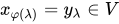 and
and  , proving the cluster property. ∎
Corollary (Convergence is inherited by subnets and detected by them).
A net converges to if and only if every subnet converges to .
Proof. If , then any subnet is eventually in every neighborhood of because of the cofinality requirement. Conversely, any net is a subnet of itself, so if all subnets converge to , then the net itself converges to . ∎
Filters
A filter on a set is a nonempty family  such that:
 and
and  ;
;- if
 , then
  ;
;
- if
 and
and  , then
  .
.
A filter  is a subfilter (i.e., is finer) than
  if
if  .
.
The neighborhood filter at is  .
.
A filter is fixed if  and free otherwise.
Filter bases
A nonempty family  is a filter base iff:
 ; and
; and- (directed by reverse inclusion) for all
 there exists
  with
with  .
.
Given a filter base  , its generated filter is

Lemma.  is a filter, and it is the smallest filter containing (i.e., if is a filter with
  , then
  ).
).
Proof.
- Nonemptiness and
 : since
  and , every
  witnesses
  , while because no
  .
.
- Upward closure: if
 via
via  and
and  , then
  , so
, so  .
.
- Finite intersections: if
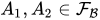 via
via  and
and  , choose with . Then
  , hence
  .
.
- Minimality is immediate from the definition. ∎
Ultrafilters
An ultrafilter is a maximal filter under inclusion.
Ultrafilter Lemma. Every filter on is contained in an ultrafilter.
Proof. Let be a filter. Partially order  by inclusion. Any chain
  has an upper bound
  , which is a filter containing all members of the chain. By Zorn’s lemma,
  has a maximal element, i.e., an ultrafilter containing . ∎
Corollary. If is infinite,  extends to a (free) ultrafilter.
Fixed ultrafilters are principal
For , the principal (or point) ultrafilter at is  .
.
Proposition. Every fixed ultrafilter  on equals
  for a unique .
Proof. Since is fixed, pick  . Then
  , and maximality yields
  . If
. If  , then
  so
so  and
and  . ∎
. ∎
Two basic ultrafilter properties
Lemma (finite-union property). If is an ultrafilter and  , then
  or
or  . Consequently, if
  , then
  for some
  .
.
Proof. Define  . Then is a filter,
  , and . By maximality,
  , hence . The
  -ary case follows by induction. ∎
Lemma (hitting every member forces membership). If is an ultrafilter and  for all , then .
Proof. The family  is a filter base (nonempty and directed). Let be its generated filter. Then
  and . Maximality forces
  , so . ∎
Corollary (dichotomy). For any and ultrafilter , exactly one of or  lies in .
Proof. Apply the finite-union property to  and note that
  . ∎
. ∎
No finite sets in a free ultrafilter
Proposition. If is a free ultrafilter on , then contains no finite subset of .
Proof. Suppose  . By the finite-union property,
  for some , which makes fixed (indeed
  ), a contradiction. ∎
Consequences. Only infinite sets admit free ultrafilters; every finite-set ultrafilter is principal.
Convergence and adherence for filters
For a filter on a topological space :
- Convergence. converges to (write
 ) iff
) iff  , where is the neighborhood filter at .
- Adherence (limit points). The adherence set (set of limit/cluster points) of is
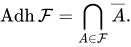
- Equivalently,
 iff every neighborhood of meets every .
Note. Some texts reserve “limit” for convergence () and use “adherent/cluster point” for  . We adopt this distinction here.
If , then (trivial since implies every meets every ).
Theorem. A space is Hausdorff iff every filter on has at most one limit (i.e., if and  , then ).
Proof.
() Suppose is Hausdorff and and . Pick disjoint neighborhoods  ,
,  . Then
  , so
, so  . But , contradicting . Hence .
() Assume every filter has a unique limit; suppose toward a contradiction that is not Hausdorff. Then there exist distinct such that no neighborhoods of and are disjoint (equivalently,  for all , ). Consider the base

This is a filter base: by the nonseparation assumption, and it is directed since  with both
 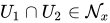 and
and 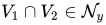 . Let
. Let  be the generated filter. Then
- For any
 , since
  we have
  . Thus
  and
and  .
.
- Symmetrically,
 (use
(use  ), so
), so  .
.
Hence has two distinct limits, contradicting uniqueness. Therefore must be Hausdorff. ∎
Adherence ⇔ existence of a convergent subfilter
Theorem. A point belongs to iff there exists a subfilter  with .
Proof.
() Assume  . For each and , . The family
 is a filter base (directed by reverse inclusion). Let be the filter it generates. Then and , hence .
() If and , then for each and each we have  , so . Thus for all , i.e. . ∎
Convergence is inherited by subfilters and detected by them
Theorem. A filter converges to iff every subfilter converges to .
Proof.
() If and , then 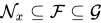 , hence .
() Every filter is a subfilter of itself, so if every subfilter converged to , then the filter converges to
Nets and filters: section filters and generated nets
Let be a net in a topological space , where is a directed set.
Section (tail) filter of a net
For each  , define the tail set

The family  is a filter base on :
- since
 ;
;
- for
 choose
  ; then
 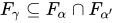 .
.
The section filter (or tail filter) of ) is the filter generated by , denoted  .
.
The adherence set of a filter is
Generated net of a filter
Given a filter on , define the directed set

(reverse inclusion on the set coordinate). The net generated by is

Basic correspondences
Lemma 1 (subnet ⇒ subfilter).
If is a subnet of (i.e., with  cofinal), then
[
\mathcal F_y\ \subseteq\ \mathcal F_x .
]
cofinal), then
[
\mathcal F_y\ \subseteq\ \mathcal F_x .
]
Proof. For some and every  , cofinality gives
 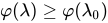 . Thus the tail
  is contained in the tail
  . Hence every base element of
  is contained in a base element of
  , so the generated filter is a subfilter of . ∎
Lemma 2 (net convergence ⇔ section filter convergence).
A net converges to iff its section filter converges to .
Proof.
 If and , choose so that for all . Then the tail
  , so
, so  . Thus
  , i.e.
  .
.
 If , then for each we have . Hence some tail , so the net is eventually in . Therefore . ∎
Lemma 3 (cluster points of a net = adherence of its section filter).
For a net ,

Proof.
( ) If is a cluster point, then for every
  and every neighborhood there exists
  with . Thus
  , so
, so  for all . Hence
 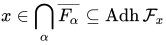 .
.
( ) If
) If  , then for each . Therefore every neighborhood meets every tail
  , so for each there exists with . This is exactly the cluster-point condition. ∎
Corollary (subnet existence).
A point is a cluster point of a net iff it is the limit of some subnet (combine the lemma with the filter theorem “adherent point ⇔ convergent subfilter” and Lemma 1).
Lemma 4 (section filter of a filter-generated net = the filter).
Let be a filter on and  its generated net. Then the section filter of this net equals .
Proof. Fix  . A tail of the net at consists of all
  with
with  , i.e. . Hence the value set of this tail is

Thus the tail base is precisely 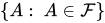 , whose generated filter is . ∎
Consequences.
- equals the set of cluster points of its generated net.
- iff the generated net converges to (use Lemma 2).
Summary of the correspondence
- Subnets vs. subfilters. Subnet section filter becomes finer (Lemma 1).
- Convergence. A net converges to iff its section filter converges to (Lemma 2).
- Cluster/adherence. Cluster points of a net are exactly the adherence points of its section filter (Lemma 3); dually, adherence points of a filter are cluster points of its generated net (Lemma 4).
- Round-trip. Starting with a filter , its generated net’s section filter is itself (Lemma 4).
Exercises
- Give a rigorous description of the following sequences of natural numbers:
(i) 
(ii) 
- Let be a set and let
 be a topology over . Let and let be a neighbourhood of .
Let  and
and  . Similarly construct neighbourhoods
  with
with  . Let
. Let  be a sequence such that each
  .
.
Prove that 