Before we begin
We briefly review the set-theoretic notion of a (possibly infinite) Cartesian product. Our formulation uses functions, which makes arbitrary index sets painless.
Cartesian product
Definition (indexed product of sets)
Let  be an index set, and for each
  let
let  be a set. The (set-theoretic) Cartesian product

is the set of all functions 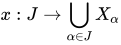 with
with  for every
  . We write such an element as
  , where
  .
.
- If all
 , then
 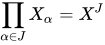 , the set of all -tuples in
  .
.
- (Empty product.) If
 , by convention is a singleton set. Topologically this will become the one-point space.
Example
Let  and
and  for each . Then

.
Product topology
Let  be topological spaces indexed by . For each
  , define the projection

There are two natural topologies one can put on the product set.
Definition (box topology)
The box topology on has as a basis all products

with each  open in (no finiteness restriction).
Definition (product topology; initial topology)
The product topology on is the topology initial with respect to the family of projections  : it is the coarsest topology making every projection continuous.
Equivalently, it is generated by the subbasis

Taking finite intersections of subbasic sets yields the familiar basis description:
Theorem (comparison of bases)
A basis for the product topology consists of all sets
with each open in and  for all but finitely many indices.
A basis for the box topology is the same formula without the finiteness condition.
Consequences. For finite products the two topologies coincide. In general, the box topology is finer (has more open sets) than the product topology.
Bases from bases
If  is a basis for , then:
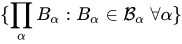 is a basis for the box topology.
 is a basis for the product topology.
Why we prefer the product topology
Many fundamental theorems extend from finite to arbitrary products only for the product topology. The key mechanism is the initial-topology/“universal property” viewpoint below, which forces continuity and limit behavior to be coordinatewise. The box topology is too fine for these extensions and is chiefly useful for counterexamples.
Continuity into a product and the universal property
We now prove the central criterion for continuity into a product space and state its categorical formulation.
Theorem (continuity via projections)
Let be spaces indexed by , give the product topology, and let  be a space. For a map
 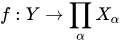 , write
  . Then
 is continuous if and only if each
  is continuous.
Proof.
- “Only if”: Each projection
 is continuous (by definition of the product topology via the subbasis
  ). Hence
  is continuous as a composition.
- “If”: It suffices to show that the preimage under of every subbasic open set is open. A typical subbasic set is
 with
with  open. Then

which is open by continuity of . Since finite intersections of such sets form a basis, is continuous. ∎
Corollary (assembling maps coordinatewise)
Given a family of maps  , there is a unique function

and  is continuous if and only if each
  is continuous.
Remark. The forward direction (“continuous into the product ⇒ all coordinates continuous”) holds for the box topology as well. The reverse fails in general for infinite products with the box topology when the product is infinite. For example, the diagonal map  ,
,  has continuous coordinates, yet is not continuous for the box topology (preimage of
  would have to contain an interval around
  , which it does not).
Categorical universal property (terminal cone)
Let  be the diagram selecting the family
  . A cone to
  with vertex is a family of morphisms
  . The product object is characterized up to unique isomorphism by the following:
Proposition. With the product topology on  and projections
  , the pair
 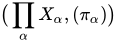 is terminal in the category of cones over : for every cone
  there exists a unique continuous map
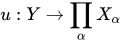
such that  for all .
Proof.
- Existence/uniqueness as a set map: Define
 ; this is the only function with the required coordinate identities, since equality in the product is coordinatewise.
- Continuity: By the theorem above,
 is continuous if and only if each
  is continuous; but morphisms in
  are precisely continuous maps, so is a valid arrow in .
Thus  is terminal among cones. ∎
Equivalently, the product topology is the initial topology on the set with respect to the family of projections  : it is the coarsest topology making all continuous. The continuity criterion above is exactly the defining property of an initial topology.
Elementary properties
- Projections are continuous and open. Each is continuous (by construction) and maps a basic open box
 to
to  , hence is an open map. Projections need not be closed in general; they are closed if all other factors are compact and the target is Hausdorff (see the compactness section for context).
- Subspaces. For subsets
 , the canonical identification
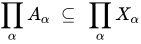
is a subspace embedding for both box and product topologies.
- Separation. If every is
 (resp. Hausdorff), then so is (for either topology). (Normality does not pass to products in general; e.g. the Sorgenfrey plane.)
- Connectedness / path-connectedness. Products of connected spaces are connected; products of path-connected spaces are path-connected (choose coordinatewise paths and use the universal property).
- Convergence. In the product topology, a sequence (or net)
 converges to
  iff each coordinate sequence (or net)
  converges to
  . (This coordinatewise description fails for the box topology.)
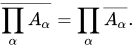
- Closures. For either topology one has
Closure of products
We give prove of the last property above, that closures commute with products in both the product and the box topology (the rest are left as an exercise).
Theorem.
Let  be spaces and
  . If
. If  is given either the product topology or the box topology, then
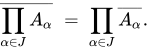
Proof.
We show the two inclusions.
(⊆) Let 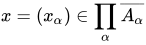 . Let
. Let  be a basic open neighborhood of . For the product topology, we may write
  with each open in and for all but finitely many indices; for the box topology, we have the same description but without the finiteness restriction.
Since  and is an open neighborhood of
  , we have
  for every . Choose
  for each , and set
  . Then
 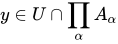 , so every basic neighborhood of meets
  . Hence
  .
.
(⊇) Let . Fix and an open set  with
with  . The set
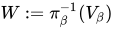
is open in either topology and contains ; by assumption, 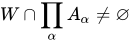 . Pick
 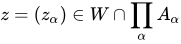 . Then
 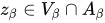 , so
, so 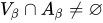 . Since
  was arbitrary,
  . As this holds for each
  , we conclude
  . ∎
. ∎
Remark (on choice).
In the first inclusion we selected one point for each index . For infinite index sets this uses the Axiom of Choice (indeed, “every product of nonempty sets is nonempty” is equivalent to Choice). No choice is needed for finite products, and the reverse inclusion does not require Choice.
Corollary (density passes to products).
If each  is dense in , then is dense in in both the product and the box topology.
Working with bases
Often each factor has a convenient basis. For Euclidean space,
- A basis of
 is the family of open intervals; thus a basis for
  (with the product topology) is all rectangles
  .
.
- For a countable product
 , a basic open set is a “cylinder” where only finitely many coordinates are restricted to intervals, the rest are all of .
Examples
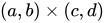
- Let
 and with the usual topology. Then the basic open sets of
  are rectangles
  :
:

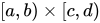
- Let and
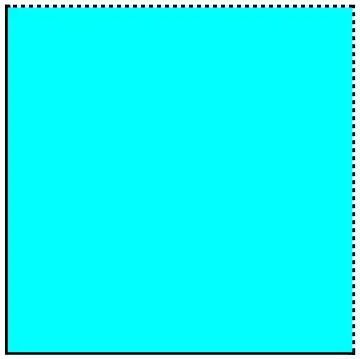
 (the Sorgenfrey line). Then a basis for the product (the “Sorgenfrey plane”) has sets of the form
  :
:
It is helpful to frame products using category theory.
- Top as a category. Objects are spaces; morphisms are continuous maps.
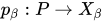
- Categorical product. An object
 with morphisms
  is a product of the family
  if for every space and maps
 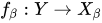 there is a unique
  with
with  for all .
In Top, the set-theoretic product with the product topology and its projections satisfies this universal property. The box topology does not (for infinite families), precisely because the “⇐” direction in the continuity theorem can fail.
- Initial topologies. Given a family of maps
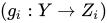 , the initial topology on makes all
  continuous and is the coarsest such topology. The product topology is the initial topology of the projections
  . Dually, quotient topologies are final topologies.
- Functoriality. Products are functorial: a family of maps
 induces

which is continuous by the coordinatewise criterion.
- Limits. Top has all small limits. In practice, limits are computed as subspaces of products cut out by equalizer conditions. This viewpoint systematically explains many “product + equations” constructions.
- Exponentials. Unlike Set or CGHaus, the category Top is not cartesian closed in general: a right adjoint to
 (an “exponential”
  ) need not exist. In well-behaved subcategories (e.g. compactly generated Hausdorff spaces), it does.
Exercises
- Show that the families described under “Bases from bases” are indeed bases.
- Verify that with the subspace topology from equals the product of the subspaces .
- Prove the Hausdorff product theorem.
- Show
 .
.
- Find which direction of the coordinatewise-continuity theorem remains true for the box topology (hint: it’s the easy one).
- For with the product topology, prove that sequence convergence is coordinatewise. Does your proof still work for the box topology?
- Let
 be the sequences that are eventually zero. Compute its closure in the product topology and in the box topology.
- For sequences
 with
with  and
and  real, show that
  is a homeomorphism of in the product topology. What fails in the box topology?
- (Universal property practice) Given a family
 , show there is a unique continuous
 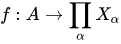 with
with  , and identify the subspace topology on
  that makes this universal for maps from a space into
  .
.