Equivalence relations
A (binary) relation  on a set
  is an equivalence relation if it is reflexive, symmetric, and transitive. A set equipped with an equivalence relation is sometimes called a setoid.
For  , the equivalence class of
  is
is ![{\displaystyle [s]={a\in S:a\sim s}}](../_assets_/eb734a37dd21ce173a46342d1cc64c92/0dace9662810286a28692d03da00c320740e425c.svg) .
The set of all equivalence classes is the quotient set
.
The set of all equivalence classes is the quotient set ![{\displaystyle S/!\sim \ ={[x]:x\in S}}](../_assets_/eb734a37dd21ce173a46342d1cc64c92/5bebf507cd3915451844f4deacfd4eb75c384edc.svg) .
.
A partition of is a family  of nonempty, pairwise disjoint subsets whose union is .
Theorem. If is an equivalence relation on , then  is a partition of .
Theorem. If is a partition of , define  iff there is
  with
with  . Then
  is an equivalence relation and
  .
.
Exercise: prove the above theorems.
Order relations
Strict vs. non-strict orders
A relation  on a set
  is a strict order if it is
- irreflexive: no
 satisfies
  ;
;
- transitive:
 and
and  imply
imply  .
.
A relation  on is a non-strict order if it is
- reflexive:
 ;
;
- antisymmetric:
 and
and  imply
imply  ;
;
- transitive.
The two notions interdefine each other:
- from strict to non-strict:
 ;
;
- from non-strict to strict:
 .
.
We will freely use either style, specifying which one is meant.
Preorders, partial orders, linear orders
Let  be a binary relation on .
- Preorder: is reflexive and transitive.
- Partial order: a preorder that is also antisymmetric.
- Total (linear) order: a partial order in which every two elements are comparable (for all
 , either
  or
or  ).
).
An ordered set is written  (non-strict) or
  (strict). A totally ordered set is also called a chain. In a partially ordered set, a chain means a totally ordered subset.
Two elements are comparable if or .
Bounds, suprema, infima; extremal elements
Let  be a partially ordered set and
  .
.
 is an upper bound of
  if
if  for all
  . Dually for lower bound.
 is the least upper bound (supremum,
  ) if it is an upper bound and
  for every upper bound
  . Dually for the greatest lower bound (infimum,
  ).
).
Proposition. If a supremum (or infimum) exists, it is unique.
Proof. If and  are both least upper bounds, then
  and
and  , hence
  . ■
. ■
Let .
 is maximal in if no
  satisfies
  .
. is the maximum of if
  for all .
(And dually for minimal/minimum.)
Note: a maximal element need not be a maximum in a partial order (elements can be incomparable).
Order-preserving maps and isomorphisms
Let  ,
,  be ordered sets.
 is order-preserving (or increasing) if
  .
. is an embedding if it is injective and order-preserving (equivalently, an isomorphism of with its image, with the induced order).
- is an isomorphism if it is bijective and both and
 are order-preserving.
- An automorphism is an isomorphism from an ordered set to itself.
Given , the initial segment determined by is  (in strict-order notation).
Well-orderings
A linear order  is a well-ordering if every nonempty subset of
  has a least element. Equivalently, there are no infinite descending chains.
Initial segments are as above: for  ,
,  .
.
We collect basic tools (proofs kept short).
Lemma (Rising Lemma). If is well-ordered and  is order-preserving, then
  for all
  .
.
Proof. If  were nonempty, let
  . Then
  , hence
  , so
, so  , contradicting minimality (since then
  ). ■
). ■
Corollary. Every order-automorphism of a well-ordered set is the identity.
Corollary (Uniqueness of isomorphism). If  are isomorphisms between well-ordered sets, then
  .
.
Lemma (No isomorphism with a proper initial segment). No well-ordered set is isomorphic to a proper initial segment of itself.
Proof. If  were an isomorphism, the Rising Lemma gives
  , but
, but  so
so  . ■
. ■
Lemma (Isomorphisms respect initial segments). If  is an isomorphism of well-ordered sets and
  , then
  .
.
Proof. If  then
then 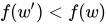 , so the restriction maps
  into
into  . Conversely, if
  , then
  , and
, and  . ■
. ■
Theorem (Comparability of well-orders). For any well-ordered sets  , exactly one holds:
 ;
;
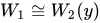 for some
  ;
;
 for some
  .
.
Proof. Define  By the previous lemmas, is single-valued, injective, order-preserving, and both
  and
and  are initial segments. If both are full sets we are in (1). If
 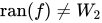 , let
, let  be the least element of
  . Then
  and necessarily
 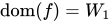 , giving (2). Symmetrically, if
 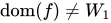 we get (3). Mutual exclusivity follows from “no self-initial-segment isomorphism”. ■
(We will use these tools again when we introduce ordinals.)
Chains and Zorn language
A chain in a poset is a totally ordered subset. We will later consider maximal chains and chain conditions (e.g. in Zorn’s Lemma) in the chapter on Choice; here we just record the terminology.
Order-type and isomorphism classes
Two linear orders have the same order-type if they are isomorphic. The theorems above imply that well-orders are linearly stratified by initial segment embedding.
Further reading / exercises
- Show that in a linear order, maximal = maximum and minimal = minimum.
- Verify the interdefinition of and given above.
- In a poset, if exists and , then
 .
.