Derivative of the inverse function
Exercise (Derivative of the inverse function)
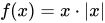
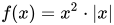
Consider the function

Justify that the following derivatives and limits exist and calculate them:
 and
and 
 and
and 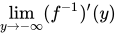
Solution (Derivative of the inverse function)
Part 1:
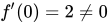
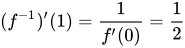
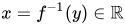
Proof step: Existence and computation of
Proof step: Existence and computation of
Part 2:
Proof step: Computation of
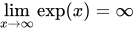
There is

So
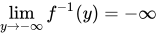
Proof step: Computation of
There is 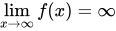 . According to the intermediate value theorem,
  is bijective. For all
  we thus have

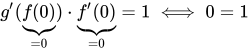
So

Derivative of a general logarithm function
Exercise (Derivative of a general logarithm function)
Show that the function

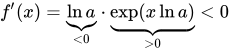
with base  is bijective and differentiable on
  . Show further that the inverse function

is differentiable on all of  with derivative
 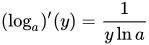 .
.
Solution (Derivative of a general logarithm function)
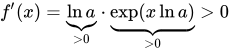
Proof step:  is bijective and differentiable
Case 1: 
Case 2: 
Proof step:  exists and is differentiable
Exercise (derivatives on

and area-functions)
Show that the functions




are differentiable, and determine their derivative.
Proof (derivatives on
and area-functions)
Differentiability of :
For the cotangent function 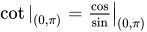 there is:
 . Thus the function is differentiable and strictly monotonically decreasing, and thus injective. Further,
  . Thus
  is bijective. The inverse function
is differentiable according to the theorem on the derivative of the inverse function, and for  there is:

Differentiability of  :
:
The hyperbolic sine function  is differentiable with
  . Thus it is strictly monotonically increasing, and hence injective. Further,
  . So it is also surjective. The inverse function
is differentiable by the theorem on the derivative of the inverse function , and for there is:

Differentiability of  :
:
The hyperbolic cosine function  is differentiable with
  on
on  . Thus it is strictly monotonically increasing, and hence injective. Further,
  . So it is also surjective. The inverse function
is differentiable by to the theorem on the derivative of the inverse function, and for  there is:

Differentiability of  :
:
For the cotangent function  there is:
  . Thus the function is strictly monotonically increasing, and thus injective. Further,
  . Thus
  is bijective. The inverse function
is differentiable by the theorem on the derivative of the inverse function, and for  there is:

Exercise (Non-differentiable functions at zero)
Let  . Show that:
- Let
 with
with  and
and  for all
  . Then and
  are not simultaneously differentiable at zero.
- Let , and let be differentiable at zero. Further let
 and
and  for all . Then is not differentiable at zero.
Derivatives of higher order
Exercise 1
Exercise (Arbitrarily often differentiable function)
Show that the function  is arbitrarily often differentiable and for all
  there is:

Proof (Arbitrarily often differentiable function)
The proof goes by induction over :
Theorem whose validity shall be proven for  bewiesen werden soll:
1. Base case:

2. Inductive step:
2a. Inductive hypothesis:
2b. Induction theorem:

2c. Proof of induction step:

Exercise 2
Exercise (Exactly one/two/three times differentiable functions)
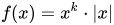
Provide an example of a
- function

- function that is differentiable, but not continuously differentiable on
- function

Solution (Exactly one/two/three times differentiable functions)
Solution sub-exercise 2:
 or
or 
Exercise 3
Exercise (Application of the Leibniz rule)
Determine the following derivatives using the Leibniz rule
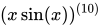
 for
for 
Solution (Application of the Leibniz rule)


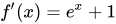



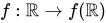
































![{\displaystyle {\begin{aligned}(x\sin(x))^{(10)}&{\underset {\text{rule}}{\overset {\text{Leibniz-}}{=}}}\sum _{k=0}^{10}{\binom {10}{k}}(x)^{(k)}(\sin(x))^{(10-k)}\\[0.3em]&\color {Gray}\left\downarrow \ (x)'=1,\ (x)^{(k)}=0{\text{ for }}k\geq 2,\ (\sin(x))^{(4k+1)}=\cos(x){\text{ and }}(\sin(x))^{(4k+2)}=-\sin(x){\text{ for all }}k\in \mathbb {N} \right.\\[0.3em]&={\binom {10}{0}}(x)^{(0)}(\sin(x))^{(10)}+{\binom {10}{1}}(x)'(\sin(x))^{(9)}\\[0.3em]&={\binom {10}{0}}x(-\sin(x))+{\binom {10}{1}}\cos(x)\\[0.3em]&=-x\sin(x)+10\cos(x)\end{aligned}}}](../_assets_/eb734a37dd21ce173a46342d1cc64c92/44cdb46a1d0ed1c5843bb4265ed3218d9db7a537.svg)


![{\displaystyle {\begin{aligned}(x^{3}\ln(x))^{(2016)}&{\underset {\text{rule}}{\overset {\text{Leibniz-}}{=}}}\sum _{k=0}^{2016}{\binom {2016}{k}}(x)^{(k)}(\ln(x))^{(2016-k)}\\[0.3em]&\color {Gray}\left\downarrow \ (x^{3})'=3x^{2},\ (x^{3})''=6x,\ (x^{3})'''=6,\ (x)^{(k)}=0{\text{ for }}k\geq 4,\ (\ln(x))^{(k)}=(-1)^{k-1}{\tfrac {(k-1)!}{x^{k}}}{\text{ for all }}k\in \mathbb {N} \right.\\[0.3em]&={\binom {2016}{0}}x^{3}(-1)^{2015}{\tfrac {(2015)!}{x^{2016}}}+{\binom {2016}{1}}\cdot 3x^{2}(-1)^{2014}{\tfrac {(2014)!}{x^{2015}}}+{\binom {2016}{2}}\cdot 6x(-1)^{2013}{\tfrac {(2013)!}{x^{2014}}}+{\binom {2016}{3}}\cdot 6\cdot (-1)^{2012}{\tfrac {(2012)!}{x^{2013}}}\\[0.3em]&=-x^{3}{\tfrac {(2015)!}{x^{2016}}}+2016\cdot 3x^{2}{\tfrac {(2014)!}{x^{2015}}}-2016\cdot 2015\cdot 3x{\tfrac {(2013)!}{x^{2014}}}+2016\cdot 2015\cdot 2014\cdot {\tfrac {(2012)!}{x^{2013}}}\\[0.3em]\end{aligned}}}](../_assets_/eb734a37dd21ce173a46342d1cc64c92/e0f6131ca98b52fa53c25f821dfa934f659213b9.svg)