Some important limits
The following limits are fundamental building bricks, which you can use to find the limits for a lot of other sequences. You should know them by heart - and have a figure in mind what they look like and how they converge:
 for all

 for all
![{\displaystyle \lim _{n\rightarrow \infty }{\tfrac {1}{\sqrt[{k}]{n}}}=0}](../_assets_/eb734a37dd21ce173a46342d1cc64c92/3cebdfd41615d2eed3bc7e4a0fdb5ff6f3b16809.svg) for all
for all  for all
  with
with 
![{\displaystyle \lim _{n\rightarrow \infty }{\sqrt[{n}]{c}}=1}](../_assets_/eb734a37dd21ce173a46342d1cc64c92/d6171a483e3617a1d72d26d373da34cc4a0fa353.svg) for all
for all 
![{\displaystyle \lim _{n\rightarrow \infty }{\sqrt[{n}]{n}}=1}](../_assets_/eb734a37dd21ce173a46342d1cc64c92/5d1dd63871920301086721f8d139653b5c276c71.svg)
 for all and
  with
with 
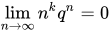 for all and with
  for all with
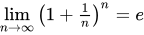
Or intuitively, polynomial beats constant, exponential beats polynomial, factorial beats exponential and  beats them all.
Constant sequences
Theorem (Limit of a constant sequence)
Every constant sequence converges to
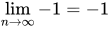
Example (Limit of a constant sequence)

How to get to the proof? (Limit of a constant sequence)
The formal proof requires to show that  for any
  and all
  . But this is rather simple, as
  , so
, so  and
and

always holds. We do not even have to care about how to choose  . For simplicity, we may just use
  . The proof now reads:
This fomulation can be simplified, since  just means that
  is a natural number:
Harmonic sequence
Theorem (Limit of the Harmonic sequence)
There is .
How to get to the proof? (Limit of the Harmonic sequence)
We have to establish the inequality  . First, let us get rid of the absolute
  :
:

So we need to find some , such that  . Which satisfy this? Let us resolve the inequality for :
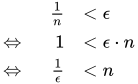
So there must be  , in order to fulfill .
Question: Which threshold
will we choose for the later proof?
How do we know that such an exist? This will be considered to be obvious in an exam or a textbook. Nevertheless, it is useful to think about the exact reasoning at least once:
Question: Why does such an
exist?
Inverse power series
Theorem
For all there is .
Inverse root sequence
Theorem
For all there is .
How to get to the proof?
The proof is almost as above. We start by simplifying ![{\displaystyle \left|{\tfrac {1}{\sqrt[{k}]{n}}}-0\right|}](../_assets_/eb734a37dd21ce173a46342d1cc64c92/af81c016bb6430b8b77a84ae2f177b814ef1f6c5.svg) :
:
![{\displaystyle \left|{\tfrac {1}{\sqrt[{k}]{n}}}-0\right|=\left|{\tfrac {1}{\sqrt[{k}]{n}}}\right|={\tfrac {1}{\sqrt[{k}]{n}}}}](../_assets_/eb734a37dd21ce173a46342d1cc64c92/3120edee4069a2967b9ca99b9ebba916cf2e45ff.svg)
Now, we resolve ![{\displaystyle {\tfrac {1}{\sqrt[{k}]{n}}}<\epsilon }](../_assets_/eb734a37dd21ce173a46342d1cc64c92/ae271bcff024c2a266081e01724b4f1bf157f113.svg) for :
for :
![{\displaystyle {\begin{array}{rrl}&{\tfrac {1}{\sqrt[{k}]{n}}}&<\epsilon \\\Leftrightarrow \ &1&<\epsilon \cdot {\sqrt[{k}]{n}}\\\Leftrightarrow \ &{\tfrac {1}{\epsilon }}&<{\sqrt[{k}]{n}}\\\Leftrightarrow \ &\left({\tfrac {1}{\epsilon }}\right)^{k}&<n\\\Leftrightarrow \ &{\frac {1}{\epsilon ^{k}}}&<n\end{array}}}](../_assets_/eb734a37dd21ce173a46342d1cc64c92/121b7aa4b37b92dfbd9b70f246c1fac28e978ffc.svg)
So we need to find an with  . This can be done by the Archimedean axiom:
Proof
Let be arbitrary. Choose  such that
  . Existence is guaranteed by the Archimedean axiom. Hence,
![{\displaystyle {\begin{array}{rrl}&N&>{\frac {1}{\epsilon ^{k}}}\\[0.3em]\Rightarrow \ &N\cdot \epsilon ^{k}&>1\\[0.3em]\Rightarrow \ &\epsilon ^{k}&>{\tfrac {1}{N}}\\[0.3em]\Rightarrow \ &\epsilon &>{\tfrac {1}{\sqrt[{k}]{N}}}\\[0.3em]\end{array}}}](../_assets_/eb734a37dd21ce173a46342d1cc64c92/106d84b59be126fd9e664698ae8b9d2dfc91e02f.svg)
Let now with  be arbitrary. There is:
![{\displaystyle {\begin{array}{rrl}&N&\leq n\\[0.5em]\Rightarrow \ &{\tfrac {1}{n}}&\leq {\tfrac {1}{N}}\\[0.5em]\Rightarrow \ &{\tfrac {1}{\sqrt[{k}]{n}}}&\leq {\tfrac {1}{\sqrt[{k}]{N}}}<\epsilon \\\end{array}}}](../_assets_/eb734a37dd21ce173a46342d1cc64c92/b205e84fbf8f69079f5dc41b02ed6c46d559fd93.svg)
Geometric series
Theorem
For all with there is .
This is now an exponentially (and no longer polynomially) decreasing sequence, so in the end, it goes to 0 even faster.
Example
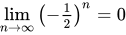
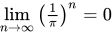
How to get to the proof?
We start again by simplifying the absolute  :
:

Using the Bernoulli's inequality we can show:
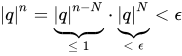
We set  . Then, there must be an with
  , which is exactly what we need. For all greater there is also:
n-th root
Theorem (Limit of a sequence with the n-th root)
For all there is .
How to get to the proof? (Limit of a sequence with the n-th root)
We need to establish an inequality like ![{\displaystyle \left|{\sqrt[{n}]{c}}-1\right|<\epsilon }](../_assets_/eb734a37dd21ce173a46342d1cc64c92/490d8e823f025cc9c4c3afffd5b9136729663d5a.svg) . First, let us focus on the proof for
. First, let us focus on the proof for  . Then,
 ![{\displaystyle {\sqrt[{n}]{c}}\geq 1}](../_assets_/eb734a37dd21ce173a46342d1cc64c92/415c1c16477ef671cfe0a640129e71d87b29c899.svg) and we can leave out the absolute:
and we can leave out the absolute:
Case 1:
Case 2: 
Proof (Limit of a sequence with the n-th root)
Case 1:
Let be arbitrary. We know that:
So there must be a natural number mit 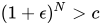 . Let be arbitrary. Then,
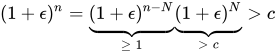
So
![{\displaystyle {\begin{array}{rrl}&c&<(1+\epsilon )^{n}\\\Rightarrow \ &{\sqrt[{n}]{c}}&<1+\epsilon \\\Rightarrow \ &{\sqrt[{n}]{c}}-1&<\epsilon \\\Rightarrow \ &\left|{\sqrt[{n}]{c}}-1\right|&<\epsilon \\\end{array}}}](../_assets_/eb734a37dd21ce173a46342d1cc64c92/a0ad8a58a2a653dcb35f5d71f38fbd817b1b3e8c.svg)
Case 2:
n-th root of n
Theorem (Grenzwert n-te Wurzel von n)
There is .
Ratio - power series / geometric series
In simple words: "exponential beats polynomial":
How to get to the proof?
This proof will be quite complicated. But it includes some useful tricks, which may help you with other proofs as well. One of those tricks is writing as  with
with  . The term
  can be multiplied out using the binomial theorem:
![{\displaystyle {\begin{aligned}\left|{\frac {n^{k}}{z^{n}}}\right|&={\frac {\left|n^{k}\right|}{\left|z^{n}\right|}}\\[0.5em]&={\frac {n^{k}}{|z|^{n}}}\\[0.5em]&={\frac {n^{k}}{(1+x)^{n}}}\\[0.5em]&\quad {\color {Gray}\left\downarrow \ {\text{binomial theorem}}\right.}\\[0.5em]&={\frac {n^{k}}{\sum \limits _{l=0}^{n}{\binom {n}{l}}x^{l}}}\end{aligned}}}](../_assets_/eb734a37dd21ce173a46342d1cc64c92/c106005aec707a01d9b2b6a4ae91db156a169b5c.svg)
The sum in the denominator is what makes this fraction complicated. It would be nice to have a more simple expression. We can achieve this by making the denominator smaller: all terms in  are positive. So if we leave summands out, we simplify the denominator and make it smaller. The entire fraction then grows. And if an enlarged fraction still converges to 0, the original one will do so, as well. The interesting question is, which terms to leave out.
Since the enumerator includes  , it may be useful to replace the denominator by some term
  with
with  not depending on . This way, we can make sure that the fraction still converges to 0 after the simplification. We will only keep this one term with
  , so
, so 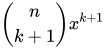 . All other terms are left out for simplicity. Multiplying out yields
  as pre-factor of the term with
  , whenever there is
  . In that case,
![{\displaystyle {\begin{aligned}{\frac {n^{k}}{\sum _{l=0}^{n}{\binom {n}{l}}x^{l}}}&\leq {\frac {n^{k}}{{\binom {n}{k+1}}x^{k+1}}}\\[0.5em]&={\frac {n^{k}}{{\frac {n\cdot (n-1)\cdot (n-2)\dots (n-k)}{(k+1)!}}x^{k+1}}}\\[0.5em]&={\frac {(k+1)!}{x^{k+1}}}\cdot {\frac {\overbrace {n\cdot n\cdot n\dots n} ^{k{\text{ factors}}}}{\underbrace {n\cdot (n-1)\cdot (n-2)\dots (n-k)} _{(k+1){\text{ factors}}}}}\\[0.5em]&={\frac {(k+1)!}{x^{k+1}}}\cdot {\frac {\overbrace {n\cdot n\cdot n\dots n} ^{k{\text{ factors}}}}{\underbrace {(n-1)\cdot (n-2)\dots (n-k)} _{k{\text{ factors}}}}}\cdot {\frac {1}{n}}\end{aligned}}}](../_assets_/eb734a37dd21ce173a46342d1cc64c92/3f2c2c8f5db2417c3db38c22d70d22bf97f96cbb.svg)
If we can now estimate the expression 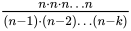 from above by something independent of , we finally have made it! The pre-factor
  remains constant in the limit process
  and cannot avoid convergence to 0. However, we will need to additionally require
  . Hence,
![{\displaystyle {\begin{aligned}n-1&={\frac {n}{2}}+\underbrace {{\frac {n}{2}}-1} _{\geq 0}\geq {\frac {n}{2}},\\[0.3em]n-2&={\frac {n}{2}}+\underbrace {{\frac {n}{2}}-2} _{\geq 0}\geq {\frac {n}{2}},\\[0.3em]\vdots &\\[0.3em]n-k&={\frac {n}{2}}+\underbrace {{\frac {n}{2}}-k} _{\geq 0}\geq {\frac {n}{2}}\end{aligned}}}](../_assets_/eb734a37dd21ce173a46342d1cc64c92/dc380ae2dbfc6695946ac0402f8d46e5cbb4269f.svg)
This in turn implies
![{\displaystyle {\begin{aligned}{\frac {n\cdot n\cdot n\dots n}{(n-1)\cdot (n-2)\dots (n-k)}}&\leq {\frac {\overbrace {n\cdot n\cdot n\dots n} ^{k{\text{ times}}}}{\underbrace {({\frac {n}{2}})\cdot ({\frac {n}{2}})\dots ({\frac {n}{2}})} _{k{\text{ times}}}}}\\[0.3em]&={\frac {n^{k}}{\frac {n^{k}}{2^{k}}}}\\[0.3em]&=2^{k}\end{aligned}}}](../_assets_/eb734a37dd21ce173a46342d1cc64c92/70d105d0a4c13a81df779ea847de8789da4ab72b.svg)
So all together,
![{\displaystyle {\begin{aligned}{\frac {n^{k}}{\sum _{l=0}^{n}{\binom {n}{l}}x^{l}}}&\leq {\frac {n^{k}}{{\binom {n}{k+1}}x^{k+1}}}\\[0.5em]&\leq {\frac {(k+1)!}{x^{k+1}}}\cdot {\frac {n^{k}}{(n-1)\cdot (n-2)\dots (n-k)}}\cdot {\frac {1}{n}}\\[0.5em]&\leq {\frac {2^{k}(k+1)!}{x^{k+1}}}\cdot {\frac {1}{n}}\end{aligned}}}](../_assets_/eb734a37dd21ce173a46342d1cc64c92/41af2472b5eeb11956a147453839d396835fffb4.svg)
Since the expression  does not depend on and
  is a null sequence, the last expression must also be a null sequence.
For a mathematically exact proof, we need to find some for every such that for all there is:
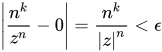
For the above estimates we need that  and
and  . Since
  for all , we can restrict to . Further
![{\displaystyle {\begin{array}{lrl}&{\frac {2^{k}(k+1)!}{x^{k+1}}}\cdot {\frac {1}{n}}&<\epsilon \\[1em]\iff \ &{\frac {2^{k}(k+1)!}{x^{k+1}}}&<\epsilon n\\[1em]\iff \ &{\frac {2^{k}(k+1)!}{x^{k+1}}}\cdot {\frac {1}{\epsilon }}&<n\end{array}}}](../_assets_/eb734a37dd21ce173a46342d1cc64c92/fc8756037ff0517641de1d7db9c06eefa007d7ec.svg)
So we need to satisfy a second condition 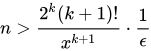 . Both conditions can be made sure to be satisfied by setting
 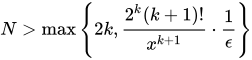 . Then, we get the desired result
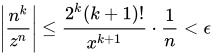
So, let's write this into a concise proof
Ratio - geometric series / factorial sequences
In simple words: "factorial beats exponential":
Theorem
Let  be a real number with . Then, .
How to get to the proof?
We need to show that  approaches 0, as goes to infinity. This will be done, by bounding it from above by a more simple expression, of which we already know that it converges to 0.
Let's take a closer look at the ratio we have to bound: Enumerator and denominator consist of an equal amount of factors ( of them). But those in the denominator are gradually increasing, whereas those in the enumerator stay constant at  . So at some
 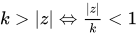 we expect the denominator to "overtake" the enumerator and finally "win against it". For making the actual bounding, we will split the sequence elements in two parts: That one, where
  has not yet overtaken will contain only a bounded amount of factors. By contrast, the part with
  will continue to grow with increasing . We choose
  as a threshold, after which " has overtaken " and consider
  . Then
![{\displaystyle {\begin{aligned}{\frac {|z|^{n}}{n!}}&={\frac {|z|\cdot |z|\cdot \ldots \cdot |z|}{1\cdot 2\cdot \ldots \cdot n}}\\[0.5em]&=\underbrace {\frac {|z|\cdot |z|\cdot \ldots \cdot |z|}{1\cdot 2\cdot \ldots \cdot M}} _{={\tfrac {|z|^{M}}{M!}}}\cdot \overbrace {\frac {|z|\cdot |z|\cdot \ldots \cdot |z|}{(M+1)\cdot (M+2)\cdot \ldots \cdot n}} ^{n-M{\text{ factors, each}}}\\&{\color {Gray}\left\downarrow \ {\tfrac {|z|}{M+1}},{\tfrac {|z|}{M+2}},\ldots ,{\tfrac {|z|}{n}}\leq {\tfrac {|z|}{M+1}}\right.}\\[0.5em]&\leq {\frac {|z|^{M}}{M!}}\cdot {\frac {|z|^{n-M}}{(M+1)^{n-M}}}\\&={\frac {|z|^{M}}{M!}}\cdot {\frac {|z|^{n}}{(M+1)^{n}}}\cdot {\frac {(M+1)^{M}}{|z|^{M}}}\\&=\underbrace {\frac {(M+1)^{M}}{M!}} _{{\text{constant w.r. to }}n}\cdot \left({\frac {|z|}{M+1}}\right)^{n}\end{aligned}}}](../_assets_/eb734a37dd21ce173a46342d1cc64c92/a521134bacbe1f7b1cc1e64acf5c044615e6ce71.svg)
Since  , the sequence
  is a geometric one and goes to 0. The factor
  is constant for increasing and does not destroy the convergence to 0. Therefore, we should be able to show
  :
:
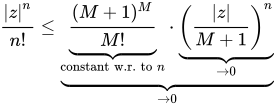
The proof can be done explicitly, using the Epsilon-definition. Let be given. We need to find an , such that for all the inequality  holds. The elements have already been bounded from above (see the inequality above). Will the right-hand side of this inequality get smaller than
  for certain ? We have
![{\displaystyle {\begin{aligned}&&{\frac {(M+1)^{M}}{M!}}\cdot \left({\frac {|z|}{M+1}}\right)^{n}&<\epsilon \\[0.5em]&\iff &\left({\frac {|z|}{M+1}}\right)^{n}&<\epsilon \cdot {\frac {M!}{(M+1)^{M}}}\end{aligned}}}](../_assets_/eb734a37dd21ce173a46342d1cc64c92/5bdab2a6598a9aef499f46ed9290a1f16b35400d.svg)
The right-hand side does not depend on . Since , the Archimedean axiom implies that there is an  , such that
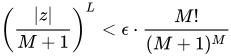
And for all greater  , there is also

Now, we have all parts together for constructing the proof. Throughout our considerations, we posed the conditions and . Both are satisfied by setting  .
.
Ratio - factorial /
In simple words: " beats factorial":
Theorem
There is .











![{\displaystyle {\begin{array}{rrl}&{\tfrac {1}{n^{k}}}&<\epsilon \\\Leftrightarrow \ &1&<\epsilon \cdot n^{k}\\\Leftrightarrow \ &{\tfrac {1}{\epsilon }}&<n^{k}\\\Leftrightarrow \ &{\sqrt[{k}]{\tfrac {1}{\epsilon }}}&<n\\\Leftrightarrow \ &{\frac {1}{\sqrt[{k}]{\epsilon }}}&<n\end{array}}}](../_assets_/eb734a37dd21ce173a46342d1cc64c92/5544d8b291a01b8bed189025e2e6c9da99a1ebba.svg)
![{\displaystyle N>{\frac {1}{\sqrt[{k}]{\epsilon }}}}](../_assets_/eb734a37dd21ce173a46342d1cc64c92/33ff48e48860bb9e4536947a70823b2ea4c7a1c7.svg)
![{\displaystyle N>{\tfrac {1}{\sqrt[{k}]{\epsilon }}}}](../_assets_/eb734a37dd21ce173a46342d1cc64c92/d3d4ea9d30714ff213295a41363cd0804b284c78.svg)
![{\displaystyle {\begin{array}{rrl}&n&\geq N\\[0.5em]&&{\color {OliveGreen}\left\downarrow \ N>{\frac {1}{\sqrt[{k}]{\epsilon }}}\right.}\\[0.3em]\Rightarrow \ &n&>{\frac {1}{\sqrt[{k}]{\epsilon }}}\\[0.3em]\Rightarrow \ &n\cdot {\sqrt[{k}]{\epsilon }}&>1\\[0.3em]\Rightarrow \ &{\sqrt[{k}]{\epsilon }}&>{\tfrac {1}{n}}\\[0.3em]\Rightarrow \ &\epsilon &>{\tfrac {1}{n^{k}}}\\[0.3em]\Rightarrow \ &\epsilon &>\left|{\tfrac {1}{n^{k}}}-0\right|\\[0.3em]\Rightarrow \ &\left|{\tfrac {1}{n^{k}}}-0\right|&<\epsilon \end{array}}}](../_assets_/eb734a37dd21ce173a46342d1cc64c92/8f8785681404fc76475217b5884e799b58260a02.svg)









![{\displaystyle \left|{\sqrt[{n}]{c}}-1\right|={\sqrt[{n}]{c}}-1}](../_assets_/eb734a37dd21ce173a46342d1cc64c92/7d03f8033f865d43cfab5a39063776c4dfa63e5c.svg)
![{\displaystyle {\sqrt[{n}]{c}}-1<\epsilon }](../_assets_/eb734a37dd21ce173a46342d1cc64c92/4261d111cc93d2e4a0c978cad848b403705b527f.svg)
![{\displaystyle {\begin{array}{rrl}&{\sqrt[{n}]{c}}-1&<\epsilon \\\Leftrightarrow \ &{\sqrt[{n}]{c}}&<1+\epsilon \\\Leftrightarrow \ &c&<(1+\epsilon )^{n}\\\end{array}}}](../_assets_/eb734a37dd21ce173a46342d1cc64c92/1339af707df76ca71c8e32caa56519fbeb5e4b7f.svg)


![{\displaystyle {\begin{aligned}\left|{\sqrt[{n}]{c}}-1\right|&=\left|{\sqrt[{n}]{\frac {1}{a}}}-1\right|\\&=\left|{\frac {1}{\sqrt[{n}]{a}}}-1\right|\\&=\left|{\frac {1-{\sqrt[{n}]{a}}}{\sqrt[{n}]{a}}}\right|\\&=\left|{\frac {1}{\sqrt[{n}]{a}}}\right|\cdot \left|1-{\sqrt[{n}]{a}}\right|\\&={\frac {1}{\sqrt[{n}]{a}}}\cdot \left|{\sqrt[{n}]{a}}-1\right|\\\end{aligned}}}](../_assets_/eb734a37dd21ce173a46342d1cc64c92/2c4343da71e38b9728092fb46322e07edaae763f.svg)
![{\displaystyle \left|{\sqrt[{n}]{a}}-1\right|}](../_assets_/eb734a37dd21ce173a46342d1cc64c92/b5944b2b07797bfe4361672dfa5cc0229c4ee45d.svg)
![{\displaystyle {\frac {1}{\sqrt[{n}]{a}}}}](../_assets_/eb734a37dd21ce173a46342d1cc64c92/b588d96e128c60cc42bdc48c5c92c6111bec5a7a.svg)
![{\displaystyle {\begin{array}{rrl}&a&>1\\\Rightarrow \ &{\sqrt[{n}]{a}}&>1\\\Rightarrow \ &{\frac {1}{\sqrt[{n}]{a}}}&<1\end{array}}}](../_assets_/eb734a37dd21ce173a46342d1cc64c92/0253dce2bb1936028b0c8d97ffd5cd6b81a4bb01.svg)
![{\displaystyle {\frac {1}{\sqrt[{n}]{a}}}\cdot \left|{\sqrt[{n}]{a}}-1\right|<\left|{\sqrt[{n}]{a}}-1\right|}](../_assets_/eb734a37dd21ce173a46342d1cc64c92/d26d88b123aff394c60917b3503e00a6e0e2e8ca.svg)
![{\displaystyle \left|{\sqrt[{n}]{a}}-1\right|<\epsilon }](../_assets_/eb734a37dd21ce173a46342d1cc64c92/2fb1c412f574a1cc9d7379f02760278cef542fb1.svg)
![{\displaystyle {\begin{aligned}\left|{\sqrt[{n}]{c}}-1\right|&=\left|{\sqrt[{n}]{\frac {1}{a}}}-1\right|\\&=\left|{\frac {1}{\sqrt[{n}]{a}}}-1\right|\\&=\left|{\frac {1-{\sqrt[{n}]{a}}}{\sqrt[{n}]{a}}}\right|\\&=\left|{\frac {1}{\sqrt[{n}]{a}}}\right|\cdot \left|1-{\sqrt[{n}]{a}}\right|\\&={\frac {1}{\sqrt[{n}]{a}}}\cdot \left|{\sqrt[{n}]{a}}-1\right|\\&<\left|{\sqrt[{n}]{a}}-1\right|\\&<\epsilon \\\end{aligned}}}](../_assets_/eb734a37dd21ce173a46342d1cc64c92/b22a9656720c5fd7c8fd5a05da79338cbe0d1784.svg)
![{\displaystyle \left|{\sqrt[{n}]{n}}-1\right|<\epsilon }](../_assets_/eb734a37dd21ce173a46342d1cc64c92/90a45caa81f61289dc5ab6c16b93dfe0380073a1.svg)
![{\displaystyle {\begin{array}{rrl}&\left|{\sqrt[{n}]{n}}-1\right|&<\epsilon \\[0.3em]&&{\color {OliveGreen}\left\downarrow \ {\sqrt[{n}]{n}}\geq 1\right.}\\[0.3em]\Leftrightarrow \ &{\sqrt[{n}]{n}}-1&<\epsilon \\\Leftrightarrow \ &{\sqrt[{n}]{n}}&<1+\epsilon \\\Leftrightarrow \ &n&<(1+\epsilon )^{n}\\\end{array}}}](../_assets_/eb734a37dd21ce173a46342d1cc64c92/b2ebd54b190fef0f3801b00cd5833f9354f430b0.svg)







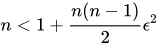

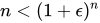
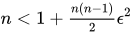
![{\displaystyle {\begin{array}{rrl}&n&<1+{\frac {n(n-1)}{2}}\epsilon ^{2}\\[0.3em]\Leftrightarrow \ &n-1&<{\frac {n(n-1)}{2}}\epsilon ^{2}\\[0.3em]\Leftrightarrow \ &1&<{\frac {n}{2}}\epsilon ^{2}\\[0.3em]\Leftrightarrow \ &2&<n\epsilon ^{2}\\[0.3em]\Leftrightarrow \ &{\frac {2}{\epsilon ^{2}}}&<n\end{array}}}](../_assets_/eb734a37dd21ce173a46342d1cc64c92/424d71d1a2c0bf1469cdefd65f98c3d4d3ed255f.svg)


![{\displaystyle {\begin{array}{rrl}&{\frac {2}{\epsilon ^{2}}}&<n\\[0.3em]\Rightarrow \ &2&<n\epsilon ^{2}\\[0.3em]\Rightarrow \ &1&<{\frac {n}{2}}\epsilon ^{2}\\[0.3em]\Rightarrow \ &n-1&<{\frac {n(n-1)}{2}}\epsilon ^{2}\\[0.3em]\Rightarrow \ &n&<1+{\frac {n(n-1)}{2}}\epsilon ^{2}\\[0.3em]&&{\color {OliveGreen}\left\downarrow \ 1+{\frac {n(n-1)}{2}}\epsilon ^{2}\leq \sum _{k=0}^{n}{\binom {n}{k}}\epsilon ^{k}=(1+\epsilon )^{n}\right.}\\[0.3em]\Rightarrow \ &n&<(1+\epsilon )^{n}\\[0.3em]\Rightarrow \ &{\sqrt[{n}]{n}}&<1+\epsilon \\[0.3em]\Rightarrow \ &{\sqrt[{n}]{n}}-1&<\epsilon \\[0.3em]&&{\color {OliveGreen}\left\downarrow \ {\sqrt[{n}]{n}}\geq 1\right.}\\[0.3em]\Rightarrow \ &\left|{\sqrt[{n}]{n}}-1\right|&<\epsilon \\[0.3em]\end{array}}}](../_assets_/eb734a37dd21ce173a46342d1cc64c92/5918727217a9e5ed73a041e0eb16149d864adb07.svg)


![{\displaystyle {\begin{aligned}\left|{\frac {n^{k}}{z^{n}}}\right|&={\frac {\left|n^{k}\right|}{\left|z^{n}\right|}}\\[0.3em]&={\frac {n^{k}}{|z|^{n}}}\\[0.3em]&={\frac {n^{k}}{(1+x)^{n}}}\\[0.3em]&\quad {\color {Gray}\left\downarrow \ {\text{binomial theorem}}\right.}\\[0.3em]&={\frac {n^{k}}{\sum _{l=0}^{n}{\binom {n}{l}}x^{l}}}\\[0.3em]&\leq {\frac {n^{k}}{{\binom {n}{k+1}}x^{k+1}}}\\[0.3em]&={\frac {(k+1)!\cdot \overbrace {n\cdot n\cdot n\dots n} ^{k{\text{ times}}}}{n\cdot (n-1)\cdot (n-2)\dots (n-k)\cdot x^{k+1}}}\\[0.3em]&={\frac {(k+1)!\cdot \overbrace {n\cdot n\cdot n\dots n} ^{k{\text{ times}}}}{\underbrace {(n-1)\cdot (n-2)\dots (n-k)} _{k{\text{ times}}}\cdot x^{k+1}}}\cdot {\frac {1}{n}}\\[0.3em]&\quad {\color {Gray}\left\downarrow \ n>2k\ \Longrightarrow \ n-1\geq {\frac {n}{2}},\ \ldots \ ,n-k\geq {\frac {n}{2}}\right.}\\[0.3em]&={\frac {(k+1)!\cdot \overbrace {n\cdot n\cdot n\dots n} ^{k{\text{ times}}}}{\underbrace {{\frac {n}{2}}\cdot {\frac {n}{2}}\dots {\frac {n}{2}}} _{k{\text{ times}}}\cdot x^{k+1}}}\cdot {\frac {1}{n}}\\[0.3em]&={\frac {2^{k}(k+1)!}{x^{k+1}}}\cdot {\frac {1}{n}}\\[0.3em]&\quad {\color {Gray}\left\downarrow \ n\geq N>{\frac {2^{k}(k+1)!}{x^{k+1}}}{\frac {1}{\epsilon }}\right.}\\[0.3em]&<{\frac {2^{k}(k+1)!}{x^{k+1}}}\cdot {\frac {1}{{\frac {2^{k}(k+1)!}{x^{k+1}}}{\frac {1}{\epsilon }}}}\\[0.3em]&={\frac {1}{\frac {1}{\epsilon }}}\\&=\epsilon \end{aligned}}}](../_assets_/eb734a37dd21ce173a46342d1cc64c92/3706ddfb7e0bd4680085a950b5ca1c43d0008836.svg)
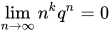


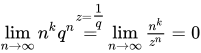

![{\displaystyle {\begin{aligned}{\frac {|z|^{n}}{n!}}&={\frac {|z|\cdot |z|\cdot \ldots \cdot |z|}{1\cdot 2\cdot \ldots \cdot n}}\\[0.5em]&={\frac {|z|^{M}}{M!}}\cdot {\frac {|z|^{n-M}}{(M+1)\cdot (M+2)\cdot \ldots \cdot n}}\\[0.5em]&{\color {Gray}\left\downarrow \ {\tfrac {|z|}{M+1}},{\tfrac {|z|}{M+2}},\ldots ,{\tfrac {|z|}{n}}\leq {\tfrac {|z|}{M+1}}\right.}\\[0.5em]&\leq {\frac {|z|^{M}}{M!}}\cdot {\frac {|z|^{n-M}}{(M+1)^{n-M}}}\\&=\underbrace {\frac {(M+1)^{M}}{M!}} _{\text{fest}}\cdot \left({\frac {|z|}{M+1}}\right)^{n}\end{aligned}}}](../_assets_/eb734a37dd21ce173a46342d1cc64c92/102b3c23fad17ad2d1d21e3a25a3c34754466f39.svg)
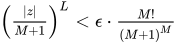

![{\displaystyle {\begin{aligned}\left|{\frac {z^{n}}{n!}}\right|&={\frac {|z|^{n}}{n!}}\\[0.5em]&\leq {\frac {|z|^{M}}{M!}}\cdot {\frac {|z|^{n-M}}{(M+1)^{n-M}}}\\[0.5em]&={\frac {(M+1)^{M}}{M!}}\cdot \left({\frac {|z|}{M+1}}\right)^{n}\\[0.5em]&\leq {\frac {(M+1)^{M}}{M!}}\cdot \left({\frac {|z|}{M+1}}\right)^{L}\\[0.5em]&<{\frac {(M+1)^{M}}{M!}}\cdot \epsilon \cdot {\frac {M!}{(M+1)^{M}}}\\[0.5em]&=\epsilon \end{aligned}}}](../_assets_/eb734a37dd21ce173a46342d1cc64c92/798e72d4a312b17b652952d11896a6c0e8315a27.svg)

![{\displaystyle {\begin{aligned}\left|{\frac {n!}{n^{n}}}-0\right|&={\frac {n!}{n^{n}}}={\frac {1}{n}}\cdot {\frac {2\cdot 3\cdot \ldots \cdot n}{n\cdot n\cdot \ldots \cdot n}}\\[0.3em]&={\frac {1}{n}}\cdot \prod _{k=2}^{n}{\frac {k}{n}}\\[0.3em]&{\color {OliveGreen}\left\downarrow \ {\frac {k}{n}}\leq 1{\text{ for all }}k\in \{2,\ldots ,n\}{\text{ and hence }}\prod _{k=2}^{n}{\frac {k}{n}}\leq 1\right.}\\[0.3em]&\leq {\frac {1}{n}}\leq {\frac {1}{{\tfrac {1}{\epsilon }}+1}}<\epsilon \end{aligned}}}](../_assets_/eb734a37dd21ce173a46342d1cc64c92/79ada81cce92dc49bcb95a252cd83b367ce59ac7.svg)