Fehler: Aktuelle Seite wurde in der Sitemap nicht gefunden. Deswegen kann keine Navigation angezeigt werden
In this chapter we will consider some properties of vector spaces which can be derived directly from the definition of a vector space. So every vector space must satisfy these properties, no matter how abstract or high-dimensional.
Overview
In this section we use again the operation symbols " " and "
 " to distinguish the vector addition and the scalar multiplication with the field addition "
 " and the field multiplication "
 ".
".
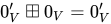
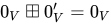
We want to derive simple properties and rules from the eight axioms of the vector space. Since we have demanded in the axioms only the existence of the zero vector and the additive inverse, the following questions arise first: Is the zero vector unique or are there several zero vectors? Is the inverse element of addition unique or can there be more than one? The answer to both questions is:
- In every vector space there is exactly one zero vector
 . So nope, there cannot be more than one zero vector in a vector space.
- The inverse with respect to addition is unique. So for every vector
 there is exactly one other vector
  with
with  .
.
Further statements that we will prove in the following are:
- For every we have that:
 .
.
- For every
 we have that:
  .
.
- From
 it follows that
  or
or  .
.
- For all and all we have that:
 .
.
In the following, we denote by  a vector space over a field
  .
.
Uniqueness of the zero vector
Theorem (Uniqueness of the zero vector)
In every vector space , the zero vector  is unique
Inverses are unique
Theorem (Inverses are unique)
The inverse with respect to addition is unique. That means, for every vector there is exactly one vector with  .
.
Proof (Inverses are unique)
Let  . We assume that
  and
and  are two additive inverses to
  . Let thus
  and
and  . We now show that
  and that there can be only one additive inverse.
![{\displaystyle {\begin{aligned}v&=\,v\,\boxplus \,0_{V}&&\\[0.3em]&\ {\color {OliveGreen}\downarrow {\text{zero vector satisfies }}{x\boxplus w=0_{V}}}\\[0.3em]&=\,v\boxplus (x\boxplus w)\\[0.3em]&\ {\color {OliveGreen}\downarrow {\text{associative law of vector addition}}}\\[0.3em]&=\,(v\boxplus x)\boxplus w\\[0.3em]&\ {\color {OliveGreen}\downarrow {\text{commutative law of vector addition}}}\\[0.3em]&=\,(x\boxplus v)\boxplus w\\[0.3em]&\ {\color {OliveGreen}\downarrow {x\boxplus v=0_{V}}}\\[0.3em]&=\,0_{V}\boxplus w=\,w\\\end{aligned}}}](./_assets_/eb734a37dd21ce173a46342d1cc64c92/8109d83213a4b3ef0ad75b5cb27f2c6c1150949f.svg)
Thus the two additive inverses and are identical.
Scaling by zero results in the zero vector
Theorem (Scaling by zero results in the zero vector)
For every we have that: .
Proof (Scaling by zero results in the zero vector)
![{\displaystyle {\begin{aligned}&0_{V}\\[0.3em]&\ {\color {OliveGreen}\downarrow {\text{vector addition by the inverse of }}{0_{K}\boxdot v}}\\[0.3em]=\ &0_{K}\boxdot v\boxplus (-0_{K}\boxdot v)\\[0.3em]&\ {\color {OliveGreen}\downarrow {\text{replace }}{0_{K}}{\text{ by }}{0_{K}+0_{K}}}\\[0.3em]=\ &(0_{K}+0_{K})\boxdot v\boxplus (-0_{K}\boxdot v)\\[0.3em]&\ {\color {OliveGreen}\downarrow {\text{scalar distributive law }}}\\[0.3em]=\ &(0_{K}\boxdot v\boxplus 0_{K}\boxdot v)\boxplus (-0_{K}\boxdot v)\\[0.3em]&\ {\color {OliveGreen}\downarrow {\text{associative law of vector addition}}}\\[0.3em]=\ &0_{K}\boxdot v\boxplus (0_{K}\boxdot v\boxplus (-0_{K}\boxdot v))\\[0.3em]&\ {\color {OliveGreen}\downarrow {\text{0 is its own additive inverse: }}{0_{K}\boxdot v\boxplus (-0_{K}\boxdot v)=0_{V}}}\\[0.3em]=\ &0_{K}\boxdot v\end{aligned}}}](./_assets_/eb734a37dd21ce173a46342d1cc64c92/36d622a8f8b0d798689b29e40c634a992e9d7fd2.svg)
So  .
.
Question: Can a vector

be multiplied with a scalar

in such a way that the original vector

is the result?
Scaling the zero vector again gives the zero vector
Theorem (Scaling the zero vector again gives the zero vector)
For all we have that: .
Proof (Scaling the zero vector again gives the zero vector)
Let be the neutral element of vector addition and arbitrary. We have that:
![{\displaystyle {\begin{aligned}&0_{V}\\[0.3em]&\ {\color {OliveGreen}\downarrow {\text{vector addition by the inverse of }}{\rho \boxdot 0_{V}}}\\[0.3em]=\ &\rho \boxdot 0_{V}\boxplus (-\rho \boxdot 0_{V})\\[0.3em]&\ {\color {OliveGreen}\downarrow {\text{replace the zero vector }}{0_{V}}{\text{ by }}{0_{V}\boxplus 0_{V}}}\\[0.3em]=\ &\rho \boxdot (0_{V}\boxplus 0_{V})\boxplus (-\rho \boxdot 0_{V})\\[0.3em]&\ {\color {OliveGreen}\downarrow {\text{vectorial distributive law}}}\\[0.3em]=\ &(\rho \boxdot 0_{V}\boxplus \rho \boxdot 0_{V})\boxplus (-\rho \boxdot 0_{V})\\[0.3em]&\ {\color {OliveGreen}\downarrow {\text{associative law of vector addition}}}\\[0.3em]=\ &\rho \boxdot 0_{V}\boxplus (\rho \boxdot 0_{V}\boxplus (-\rho \boxdot 0_{V}))\\[0.3em]&\ {\color {OliveGreen}\downarrow {\text{0 can be written as }}{\rho \boxdot 0_{V}\boxplus (-\rho \boxdot 0_{V})=0_{V}}}\\[0.3em]=\ &\rho \boxdot 0_{V}\\\end{aligned}}}](./_assets_/eb734a37dd21ce173a46342d1cc64c92/3461c8b8031ed9e9b8258ab877e202795dbdf6a5.svg)
So 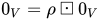 .
.
Scalar multiplication leaves no zero divisors
Scaling by a negative scalar
Theorem (Scaling by a negative scalar)
For all and all we have that
Proof (Scaling by a negative scalar)
By the scalar distributive law for scalar multiplication we have on one hand:
![{\displaystyle {\begin{aligned}&(\rho \boxdot v)\boxplus ((-\rho )\boxdot v)\\[0.3em]&{\color {OliveGreen}\downarrow (\lambda +\rho )\boxdot v=(\lambda \boxdot v)\boxplus (\rho \boxdot v)}\\[0.3em]=\ &(\rho +(-\rho ))\boxdot v\\[0.3em]=\ &0_{K}\boxdot v\\[0.3em]=\ &0_{V}\end{aligned}}}](./_assets_/eb734a37dd21ce173a46342d1cc64c92/ab90ef5df9b7f9aa993d1acac70c9e4d66488387.svg)
This shows that  is the additive inverse of
  . Thus
  . On the other hand, according to vectorial distributive law.
![{\displaystyle {\begin{aligned}&(\rho \boxdot v)\boxplus (\rho \boxdot (-v))\\[0.3em]&{\color {OliveGreen}\downarrow \lambda \boxdot (v\boxplus w)=(\lambda \boxdot v)\boxplus (\lambda \boxdot w)}\\[0.3em]=\ &\rho \boxdot (v\boxplus (-v))\\=\ &\rho \boxdot 0_{V}\\=\ &0_{V}\end{aligned}}}](./_assets_/eb734a37dd21ce173a46342d1cc64c92/6da585fed2ec55d2a52355a727c89ea24fbc0ad0.svg)
This shows that  is the additive inverse of , so it is equal to
  . Thus, in total
Hint
From the above theorem, we immediately get  . This follows from
  (where we have used
  ).
).
Fehler: Aktuelle Seite wurde in der Sitemap nicht gefunden. Deswegen kann keine Navigation angezeigt werden






![{\displaystyle {\begin{aligned}\rho ^{-1}\boxdot (\rho \boxdot v)&=(\rho ^{-1}\cdot \rho )\boxdot v\\&=1\boxdot v\\[0.3em]&{\color {OliveGreen}\left\downarrow \ {\text{axiom: }}1\boxdot v=v\right.}\\[0.3em]&=v\end{aligned}}}](./_assets_/eb734a37dd21ce173a46342d1cc64c92/1b042c8ed10d7fcb401d66cb5d4e850007a62429.svg)





![{\displaystyle {\begin{aligned}&v\\[0.3em]&{\color {OliveGreen}\downarrow {\text{axiom: }}1\boxdot v=v}\\[0.3em]=\ &1\boxdot v\\[0.3em]=\ &(\rho ^{-1}\rho )\boxdot v\\[0.3em]&{\color {OliveGreen}\downarrow {\text{associative law for scalars }}}\\[0.3em]=\ &\rho ^{-1}\boxdot (\rho \boxdot v)\\[0.3em]&{\color {OliveGreen}\downarrow \rho \boxdot v=0_{V}}\\[0.3em]=\ &\rho ^{-1}\boxdot 0_{V}\\[0.3em]&{\color {OliveGreen}\downarrow {\text{theorem (already proven), that for all }}\gamma \in K{\text{ we have }}\gamma \boxdot 0_{V}=0_{V}}\\[0.3em]=\ &0_{V}\end{aligned}}}](./_assets_/eb734a37dd21ce173a46342d1cc64c92/a2a31e6c1b16c8397afbc26758735f7087a3e369.svg)
