Drinking Water/Seawater desalination
The Seawater desalination is a way to produce drinking water.Similar way possible to produce clean water from grey water.
Seawater heat vaporisation
Based on Drinking water distillation method.
Industrial way
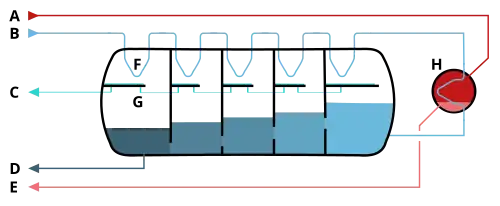
A – steam in B – seawater in C – potable water out
D – brine out (waste) E – condensate out F – heat exchange G – condensation collection (desalinated water)
H – brine heater
The pressure vessel acts as a countercurrent heat exchanger. A vacuum pump lowers the pressure in the vessel to facilitate the evaporation of the heated seawater (brine) which enters the vessel from the right side (darker shades indicate lower temperature). The steam condenses on the pipes on top of the vessel in which the fresh sea water moves from the left to the right.
Reverse osmosis
Around the world, household drinking water purification systems, including an RO step, are commonly used for improving water for drinking and cooking.
Such systems typically include these steps:
- a sediment filter to trap particles, including rust and calcium carbonate
- a second sediment filter with smaller pores
- an activated carbon filter to trap organic chemicals and chlorine, which degrades certain types of thin-film composite membrane
- an RO thin-film composite membrane
- an ultraviolet lamp for sterilizing any microbes that survive RO
- a second carbon filter to capture chemicals that survive RO
In some systems, the carbon prefilter is replaced by a cellulose triacetate (CTA) membrane. CTA is a paper by-product membrane bonded to a synthetic layer that allows contact with chlorine in the water. These require a small amount of chlorine in the water source to prevent bacteria from forming on it. The typical rejection rate for CTA membranes is 85–95%.
To work effectively, the water feeding to these units should be under pressure (typically 280 kPa (40 psi) or greater).[1]
Sources
- w:Reverse_osmosis Top editors: Lfstevens, WaterScienceProf, Desalinfo, StanfordPwr.
- ↑ Knorr, Erik Voigt, Henry Jaeger, Dietrich (2012). Securing Safe Water Supplies : comparison of applicable technologies (Online-Ausg. ed.). Oxford: Academic Press. p. 33. ISBN 978-0124058866.