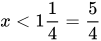
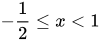
Convert to interval notation
1.


2.
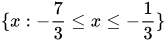
![{\displaystyle \mathbf {[-{\frac {7}{3}},-{\frac {1}{3}}]} }](../../_assets_/eb734a37dd21ce173a46342d1cc64c92/b104122048fc9e635f5545b75af6c00aaa4ea1a0.svg)
3.


4.

![{\displaystyle \mathbf {(-\infty ,{\frac {17}{9}}]} }](../../_assets_/eb734a37dd21ce173a46342d1cc64c92/9fd3ae67b4ccc96a3eed21c083909143ebe903f7.svg)
7.

8.

9.

This is equivalent to


10.

It helps to draw a picture to determine the set of numbers described:

A number in the set can be on either the red or blue line, so the entire number line is included.

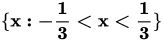
State the following intervals using set notation
11.
![{\displaystyle [3,4]\,}](../../_assets_/eb734a37dd21ce173a46342d1cc64c92/63aa416567092878c39b1a4fe774147243396e87.svg)

12.


13.


14.

15.

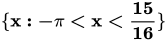
16.


Which one of the following is a true statement?
17.

Let

. Then
 , and
, and

Thus, 
false 18.

Using the same example as above, we have

.
false 19.

Evaluate the following expressions
20.

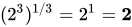
21.


22.


23.
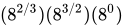

24.
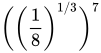

25.
![{\displaystyle {\sqrt[{3}]{\frac {27}{8}}}}](../../_assets_/eb734a37dd21ce173a46342d1cc64c92/c81839c276466ff1ed552c297e24958adeda30c7.svg)
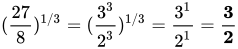
26.


27.


28.
![{\displaystyle {\frac {\sqrt {27}}{\sqrt[{3}]{9}}}}](../../_assets_/eb734a37dd21ce173a46342d1cc64c92/b940bef569d6d574c586d438a4cc7e69237a9024.svg)
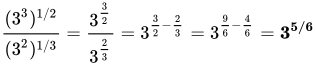
Simplify the following
29.


30.


31.


32.


33.


34.


35.


36.


Find the roots of the following polynomials
37.


38.


39.
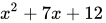

40.
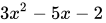
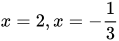
41.

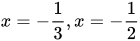
42.

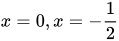
43.


44.


Factor the following expressions
45.


46.


47.


Simplify the following
48.


49.
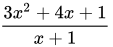

50.
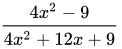

51.
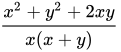
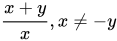
Functions
52. Let  .
.
a. Compute

and

.

,

b. What are the domain and range of

?
The domain is
; the range is

,
c. Does
have an inverse? If so, find a formula for it.
No, since
isn't one-to-one; for example,

.
53. Let 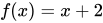 ,
,  .
.
- a. Give formulae for
i.


.
ii.


.
iii.


.
iv.


.
v.


provided

. Note that 0 is not in the domain of
, since it's not in the domain of

, and you can't divide by something that doesn't exist!
vi.

![{\displaystyle (g/f)(x)=1/[x(x+2)]}](../../_assets_/eb734a37dd21ce173a46342d1cc64c92/9420d62f75928eb145c0933455cda94fe9b406be.svg)
. Although 0 is still not in the domain, we don't need to state it now, since 0 isn't in the domain of the expression
![{\displaystyle 1/[x(x+2)]}](../../_assets_/eb734a37dd21ce173a46342d1cc64c92/c88b915e8cb5ba979495a707385342f8f93b6274.svg)
either.
vii.


.
viii.


.
b. Compute

and

.
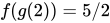
;
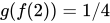
.
c. Do
and
have inverses? If so, find formulae for them.
Yes;
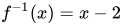
and
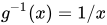
. Note that
and its inverse are the same.
54. Does this graph represent a function?
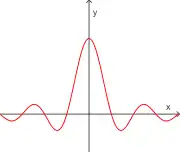
As pictured, by the Vertical Line test, this graph represents a function.
55. Consider the following function
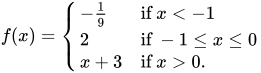
a. What is the domain?

b. What is the range?

c. Where is
continuous?

56. Consider the following function
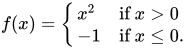
a. What is the domain?
b. What is the range?

c. Where is
continuous?
57. Consider the following function
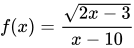
a. What is the domain?

b. What is the range?
c. Where is
continuous?

58. Consider the following function

a. What is the domain?

b. What is the range?
c. Where is
continuous?

Graphing
59. Find the equation of the line that passes through the point (1,-1) and has slope 3.

60. Find the equation of the line that passes through the origin and the point (2,3).



![{\displaystyle \mathbf {[4,5]} }](../../_assets_/eb734a37dd21ce173a46342d1cc64c92/0b442569fbd0f32e69e66da80ad816bb9fb9005c.svg)