Basic Limit Exercises
1.
![{\displaystyle \lim _{x\to 2}[4x^{2}-3x-1]}](../../_assets_/eb734a37dd21ce173a46342d1cc64c92/7958a07953b0d16449976f0e03777a498aa6b81b.svg)
Since this is a polynomial, two can simply be plugged in. This results in

2.


3.
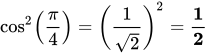
![{\displaystyle \lim _{x\to {\frac {\pi }{4}}}{\Big [}\cos ^{2}(x){\Big ]}}](../../_assets_/eb734a37dd21ce173a46342d1cc64c92/b2b628dde4a64c213ceea9a932bba29f50ebe270.svg)
4.
![{\displaystyle \lim _{x\to 1}{\Big [}5e^{x-1}-5{\Big ]}}](../../_assets_/eb734a37dd21ce173a46342d1cc64c92/1fbd3c44c22819b3d1cfe0b427d665f4742f96bc.svg)

One-Sided Limits
Evaluate the following limits or state that the limit does not exist.
5.
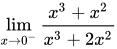
Factor as

. In this form we can see that there is a removable discontinuity at

and that the limit is

6.
![{\displaystyle \lim _{x\to 7^{-}}[|x^{2}+x|-x]}](../../_assets_/eb734a37dd21ce173a46342d1cc64c92/04720d54346c7ca54718a8a4ac5a80c1b90e7707.svg)

7.
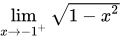

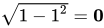
is defined if

, so the limit is
8.
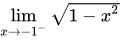
is not defined if

, so
the limit does not exist. 9.

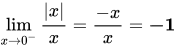
If approaching from the left, then

. Thus,
10.
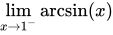

is defined from
![{\displaystyle x\in \left[-1,1\right]}](../../_assets_/eb734a37dd21ce173a46342d1cc64c92/3e9e06e4c1decbfbdf115f96295623dc0e7437c5.svg)
, so the limit is
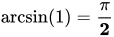
.
Two-Sided Limits
Evaluate the following limits or state that the limit does not exist.
11.


12.

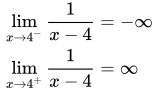 The limit does not exist.
 14.


15.


16.
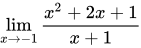

17.


18.
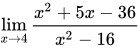

19.
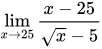

21.
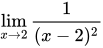
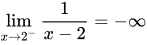
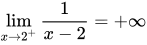
As

approaches

, the denominator will be a very small positive number, so the whole fraction will be a very large positive number. Thus, the limit is

.
22.
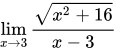
As
approaches

, the numerator goes to 5 and the denominator goes to 0. Depending on whether you approach
from the left or the right, the denominator will be either a very small negative number, or a very small positive number. So the limit from the left is

and the limit from the right is

. Thus,
the limit does not exist. 23.
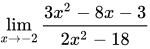

24.
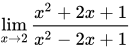

26.
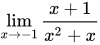

27.

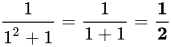
28.
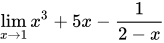

29.
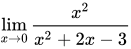
The numerator evaluates to

while the denominator evaluates to

. Hence,
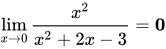
.
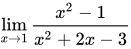
30.

31.
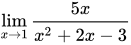
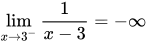
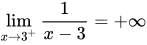
Notice that as
approaches

, the numerator approaches

while the denominator approaches
. However, if you approach from below, the denominator is negative, and if you approach from above, the denominator is positive. So the limits from the left and right will be
and
respectively. Thus,
the limit does not exist. 32.
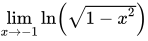
Notice how

.


Thus,
the limit does not exist.
33.
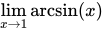
Notice that
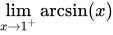 does not exist since the domain of
  is
is 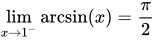
Thus,
the limit does not exist.
Limits to Infinity
Evaluate the following limits or state that the limit does not exist.
34.
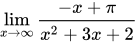
This rational function is bottom-heavy, so the limit is

.
35.
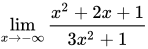
This rational function has evenly matched powers of
in the numerator and denominator, so the limit will be the ratio of the coefficients, i.e.

.
36.
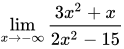
Balanced powers in the numerator and denominator, so the limit is the ratio of the coefficients, i.e.

.
37.
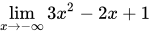
This is a top-heavy rational function, where the exponent of the ratio of the leading terms is
. Since it is even, the limit will be
.
38.
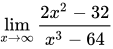
Bottom-heavy rational function, so the limit is
.
39.

This is a rational function, as can be seen by writing it in the form

. Since the powers of
in the numerator and denominator are evenly matched, the limit will be the ratio of the coefficients, i.e.

.
40.
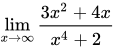
Bottom-heavy, so the limit is
.
41.
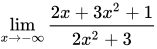
Evenly matched highest powers of
in the numerator and denominator, so the limit will be the ratio of the corresponding coefficients, i.e.
.
42.
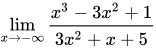
Top-heavy rational function, where the exponent of the ratio of the leading terms is
, so the limit is

.
43.

Bottom-heavy, so the limit is
.
44.


, so
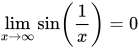
. From this,
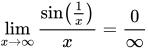
. Because

for any
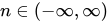
,
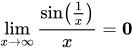
.
45.
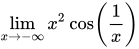

46.
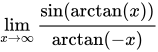
Notice that
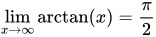
. Because

,

Limits of Piecewise Functions
Evaluate the following limits or state that the limit does not exist.
48. Consider the function
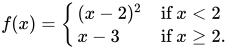
a.

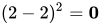
b.


c.

Since the limits from the left and right don't match, the limit does not exist.
49. Consider the function
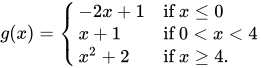
a.


b.


c.


d.

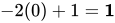
e.

Since the left and right limits match, the overall limit is also

.
f.


50. Consider the function
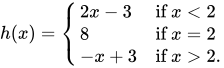
a.


b.


c.


d.

Since the limits from the right and left match, the overall limit is
. Note that in this case, the limit at 2 does not match the function value at 2, so the function is discontinuous at this point, hence the function is nondifferentiable at this point as well.
51. Use the intermediate value theorem to show that there exists a value

for
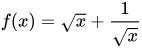
from

. If you cannot use the intermediate value theorem to show this, explain why.
Notice

is continuous from
![{\displaystyle x\in \left[1,9\right]}](../../_assets_/eb734a37dd21ce173a46342d1cc64c92/c382323526a3226306c482a7e21229542942994b.svg)
. Ergo, the intermediate value theorem applies. For all
![{\displaystyle y\in \left[2,{\frac {10}{3}}\right]}](../../_assets_/eb734a37dd21ce173a46342d1cc64c92/67f7bb544ddc2a11b3554f7b3e3045c62bfd10f9.svg)
, there exists a

so that

.
52. Use the intermediate value theorem to show that there exists an

so that

for
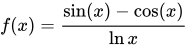
from

. If you cannot use the intermediate value theorem to show this, explain why.
Notice
is continuous from
![{\displaystyle x\in \left[\pi ,{\frac {9}{4}}\pi \right]}](../../_assets_/eb734a37dd21ce173a46342d1cc64c92/98277867d64ec64dd50b50a028ca57eaf0b9006e.svg)
. Ergo, the intermediate value theorem applies.
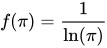
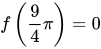
It is known the following is true:  . From there, we can directly argue the following:
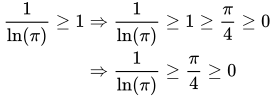
By the intermediate value theorem, if
is continuous from
, then there exists an
so that
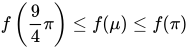
for
![{\displaystyle \mu \in \left[\pi ,{\frac {9}{4}}\pi \right]}](../../_assets_/eb734a37dd21ce173a46342d1cc64c92/39312b6220ae96b3cbd7da6667e8205f57963de8.svg)
.

53. Use the intermediate value theorem to show that there exists a value

so that

for

from

. If you cannot use the intermediate value theorem to show this, explain why.
Notice
is not continuous for
since

is unbounded. Ergo, the intermediate value theorem cannot be used to solve this problem.